Showing posts with label apologetics. Show all posts

20 Years Blogging!


​Well, I'm not sure what happened to this article! It was posted on October 1st, (the anniversary of the first blog post is October 18th, 2002), and somehow it all but disappeared! So, I am rewriting it and republishing it now.

In 1966 my father-in-law, Francis, (who became my father-in-law in 1981) started the Arizona Catholic Truth Society, or ACTS for short. This was, as we call it today, a "snail-mail" group. He had many subscribers and he sent out a monthly newsletter. 

In 1988, shortly after my conversion to the Catholic Faith, I was starting an apologetics apostolate of my own and was looking for a good name (Proverbs 22:1) and Francis offered me "ACTS" as he was no longer active in his mailing list. I like the name and accepted his offer to take it over. I started the ACTS Email list in 1988. Within a year or two, ACTS was going nationwide, actually worldwide, so I changed from "Arizona Catholic Truth Society" to the "American Catholic Truth Society." ACTS continues to this day as a website and host to several forums, including this one, Qui Locutus.

Qui Locutus was originally started in October of 1992 as the "CathApol Blog." However, my nickname was also "CathApol" and I was not the only one blogging here, so in 2017 I renamed the blog to Qui Locutus, which is taken from the Apostles Creed in Latin "qui locutus est per prophetas" ("who spoke through the prophets") so in short, the name means "Who Spoke."

Outside participation has slowed here in the last few year, I think mostly due to my going back to school in 2016, receiving my masters degree in 2018, and the same year I started working on my doctorate - which as of this writing is nearly complete (working on my dissertation). Hopefully things will pick up again soon - but if you are reading along and see something you wish to comment on, PLEASE DO! Do not wait for me to finish the doctorate! I still jump in as I can and post things of interest to me - and I hope to you too. 

May God bless all those who read along here and guide them to the fullness of Truth - which can only be found in the One, Holy, Catholic, and Apostolic Church.

In JMJ,

Scott Windsor<<<

The Catholic Debate Forum


The Catholic Debate Forum, CDF, is coming back! After a long hiatus when Yahoo shut down all yahoogroups (and Scott was too busy with school!) it is coming back! We're trying Free Forums, so come on over - give it a shot!

https://catholicdebateforum.freeforums.net/ 

Help bring back our old membership and invite new friends and challengers!

AMDG,

Scott<<<

aka: CathApol


Jacob Prasch - Questions for Catholics

Questions for Catholics Series:
Prompted by his priest, Scott Windsor responds to James Jacob Prasch (Jacob Prasch) who asks "Five Questions For Catholics" or is it "Thirty-Three Questions For Catholics?"  Prasch, the chief behind Moriel Ministries, is lashing out against Catholicism and is answered in this seven part series:
Part 1 - Should I Believe Mary or the Vatican?
Part 2 - Questions of "Co-"
Part 3 - Purgatory
Part 4 - The Rock 
Part 5 - The Eucharist and John 6
Part 6 - Doctrines of Demons?
Part 7 - Call No Man Father and the Mass


I would also point out, Mr. Prasch's challenge was answered over three years ago, at the time of this posting, and we still have no response from him. He was taken quite ill about the time of the initial responses, which Prasch himself challenged Catholics to engage him as he would like to engage further.  We have heard nothing from him yet, and we trust and pray that he has recovered from the infection which hospitalized him and look forward to his responses.


Ten Areas of Deceptions of Catholics Part III

I've already dealt with three of the "Ten Areas of Deception" in my previous two posts:

Part I,

[1] Roman Catholics are dangerously taught that they were born again at infant baptism.
[2] Roman Catholics dangerously think they receive Christ when they partake of the communion wafer.
I debunked both of these as "deceptions" in Part I. We, Catholics, do believe that we are born again at baptism, because that is what it implies, if not outright says so, in Scripture. And, yes, we believe that we receive Christ in the Holy Eucharist, because that is what Jesus Christ did say directly.

and Part II.

[3]  Roman Catholics wrongly think their church system was founded by Jesus on Peter the first pope.
Yes, we do believe that the Church was founded by Jesus on Peter, the Rock. We believe it because Jesus Christ said it. The post got long so I left it with debunking this, too, as a "deception." Both Scripture and the Apostolic Tradition of the Church prove this belief to be true and not a deception.

The next two "deadly deceptions" have to do with Mary so I thought I'd do them in one post. First:
[4] Catholics think Mary is their life, sweetness, and hope and promote her as such when they recite the rosary, which they say is the epitome of the whole gospel.
Let me talk about this so-called "deception" before I go onto his side arguments under this one.
I'm not sure how many times a Catholic can reiterate that Mary has no super power of her own and that Catholic Church does not teach that she does, and have a Protestant believe it.
Mary is our life because the Father chose her to carry the Life of the World--His Son Jesus Christ.
Mary is our sweetness because the Father chose her to carry the Sweetness of the World--His Son, Jesus Christ.
Mary is our hope because the Father chose her to carry the hope of the world--His Son, Jesus Christ.
We love Mary and honor her because she is GOD's Mother. If you believe that Jesus Christ is God incarnate, why do you not honor Mary His mother? Honoring Mary does not diminish our worship of her Son, Jesus Christ; it actually enhances out love of Him by loving and honoring His mother.  After all, her "soul magnified the Lord." (Luke 1:46)

As for the Rosary, it is the epitome of the Gospel. It is the definition ("a perfect example: an example represents or expresses something very well"--Merriam-Webster.com) of an epitome of the Gospel. I would venture to guess that the anonymous author has no idea what the Rosary is or what it is made up of. The Rosary is a series of prayers, yes, but it also contains meditations, things that you are to meditate on during your prayers. The 20 meditations (meditated on during each decade-ten beads-of the Rosary) are as follows:
The Joyful Mysteries:
1) The Annunciation: Luke 1:35-38
2) The Visitation; Luke 1:41-42
3) The Nativity (The birth of Jesus Christ); Luke 2:6-7
4) The Presentation; Luke 2:25-40
5) The Finding of Jesus in the Temple; Luke 2:46-47
Thus you will have complete a complete round of the Rosary beads and prayed the story of Jesus and Mary in the Gospel of Luke. Last time I heard Luke's book was considered a Gospel.
Next are the Luminous Mysteries (added to the traditional Rosary by Saint John Paul II)
1) The Baptism of Jesus; Mark 1:9-11
2) The Miracle at the Wedding Feast at Cana; John 2:5-8
3) The Proclamation of the Kingdom of God; Mark 1:15
4) The Transfiguration; Matthew 17:2-5
5) The Institution of the Eucharist; Matthew 26:26-28
Here is another complete round of the Rosary beads. Matthew, Mark, and John also being authors of books called Gospel.
Which brings us to the Sorrowful Mysteries:
1) The Agony in the Garden; Mark 14:33-36
2) The Scourging at the pillar; John 19:1
3) The Crowning with Thorns; Mark 15:17
4) Carrying of the Cross; Luke 23: 27-28
5) The Crucifixion; John 19:33-35
And, next the Glorious Mysteries:
1) The Resurrection; John 20:1
2) The Ascension; Acts 1:7-9
3) The Descent of the Holy Spirit; Acts 2:2-4
4) The Assumption of Mary; Luke 1:30
5) The Coronation of Mary, Queen of Heaven; Revelation 12:1
You can find, online, several places where you can pray a "scriptural Rosary", where there is a Scripture passage for each of the ten beads of each meditation. There is one here, or here, or even this one. The Meditations of the Rosary are very Scriptural and definitely are the "epitome", an excellent example, of the Gospel.

As for Protestant objections to praying to Mary in this way, I would like to reiterate that we actually ask Mary to pray for us. All our prayers are directed straight to Jesus. This is the very same thing we do when we ask a friend, a minister, or a family member to pray for us to God. The difference is that we know that Mary is beside her Son, and has His ear. What mother doesn't have some influence over her son?
"...she is rightly called not only the mother of the man, but also the Mother of God...it is certain that Mary is the Mother of the real and true God."  --Martin Luther; Sermon on John 14:16
"Men have crowded all her glory into a single phrase: The Mother of God. No one can say anything greater of her, though he had as many tongues as there are leaves on the trees." --Martin Luther; Commentary on the Magnificat. Source.
Even the father of the Protestant movement, Martin Luther, disagrees with the author of this post. Under this "deception" he made this comment (yes, I skipped a little of his comments that were redundant).

Catholicism has erected a false Mary, which has a primary role in people's salvation. Such has misled many sincere people.
Again, all I can say is that the author has no idea what place Mary has in the Church. She is the Mother of God. If she had not said yes to God, Jesus would not have been born. Don't get me wrong, I do believe God could have done it any other way--BUT HE DIDN'T. He prepared the perfect "vessel", mother, and then gave her a choice to obey or not. She said, "yes" and became the mother of God Incarnate. How could that not be special? How could one say she has no place in salvation history? It actually makes no logical sense to say that Mary had nothing to do with it. However the author of this diatribe says:
Mary plays absolutely no role in our salvation.
She had the biggest role of any human being in our salvation. She carried our salvation in her human body. She nursed our salvation at her breast. She bounced our salvation on her knee.
Then he says:
This means you cannot trust in being a Catholic, the sacraments and/or Mary along with the Lord Jesus. You must trust in Jesus alone (100%). That implies a turning away from sin.
Another statement that makes this or any informed Catholic see that this author has no idea what the Catholic Church is or teaches. But let's just look at the surface of this statement. Why must there be an either/or. To me, he is also condemning himself with this statement because he says that you must trust in Jesus Christ 100%. Does he also say that his one rule or authority of faith is the Bible? Then he is putting his trust in something other than Jesus Christ, is he not? Yes, the Scriptures testify to Jesus and His ministry, but it also attests to Mary's place in that ministry, in the Apostles commission from Jesus continuing that ministry, and to the foundation of His Church which continues His ministry.

The Church does not imply the turning away from sin but outright preaches it. We worship and obey Jesus' commands. All of the Sacraments were founded by Jesus and He commanded the Apostles to teach them. And, the Church does not teach that Mary is Jesus' equal, never has, but does teach that He loves and honors His mother and that she prays for and loves all of His followers. She sees us all as her children. We, Catholics, do trust in Jesus alone, 100%; we just don't see that we must dishonor someone in order to honor Jesus Christ our Savior.

His next question has to do with Mary also, so I thought I'd include it here.
[5] Catholics think if they die wearing the brown scapular they will not suffer the fires of hell.
For one thing, it is obvious that the anonymous author knows nothing about sacramentals. Sacramentals are "sacred signs instituted by the Church to prepare us to receive the fruit of the sacraments and to sanctify different circumstances of our lives" (CCC 1677). They are the little things that bring us out of our ordinary lives and help us think of spiritual things and tell other people we are Catholic. The Rosary is a sacramental, so is the brown scapular. You can read more on sacramentals here.
 "The promise that wearing [the brown scapular] will ensure that a person who wears is guaranteed heaven. This guarantee is based on a misunderstanding of Our Lady of Mount Carmel's promise to St. Simon Stock that "whosoever dies clothed in this scapular shall not suffer eternal life."" --Michelle Arnold, staff Apologist, Catholic Answers
 People who say that a certain prayer or a certain thing will guarantee anything, including salvation, heaven, or to get out of Heaven is engaging in superstition which is strictly against Catholic teaching.

The brown scapular of Our Lady of Mount Carmel is best understood in the context of our Catholic Faith. It offers us a rich spiritual tradition that honors Mary as the first and foremost of her Son's disciples. This scapular is an outward sign of the protection of the Blessed Virgin Mary, our sister, mother, and queen. It offers an effective symbol of Mary's protection to the Order of Carmel--its members, associates, and affiliates--as they strive to fulfill their vocation as defined by the Carmelite Rule of Saint Albert: "To live in allegiance to Jesus Christ." --Michelle Arnold, staff Apologist, Catholic Answers.
[I thought Ms. Arnold's explanations of the scapular were excellent.]
In other words, the brown scapular is not a lucky charm; you can't just put it on and be saved from hell. The Church does not teach that and the Carmelites do not teach that. The promise is for those who wear the brown scapular as a sign of their devotion and allegiance to Jesus Christ. Your devotion to Jesus Christ and His teachings are what will save you from hell. If you are wearing it as a talisman, or a good luck charm, the promise is not valid. It is as simple as that.
Read Ms. Arnold's article for an excellent explanation of the brown scapular and the promise attached to it.
So, to answer about this as a "deception", it is actually a misunderstanding of what a sacramental is and what the brown scapular as a sacramental is and what it can do. The scapular is a sign, like wearing a cross or crucifix around one's neck to proclaim to the world that one is a Christian. The scapular tells the world that one is a Carmelite or follow that Carmelite way of prayer and devotion to Jesus. 

That is long enough for this post.

[6] Catholics think the sacraments are a means of them receiving grace needed for salvation.
[7] Catholics confess their sins to a priest instead of to God.
[8]  Catholics who read and believe the Fatima Visions are dangerously thinking that Mary is our refuge and the way that will lead them to God.
[9] Many Catholics are just hoping to enter Purgatory and there get purged of their sins to afterwards go to Heaven.
[10] Catholics have been lethally misinformed about how to show their love for the Lord Jesus.

Catholic vs. Protestant -- why is there so much animosity?

I found an article on gotquestions?.org. I thought this site was a neutral site on religion, but boy was I ever wrong. It is a Protestant site that holds nothing back. In the article "Catholic vs. Protestant -- why is there so much animosity?", I detected a lot of animosity toward Catholics.

That was the question. The author's answer and some of my comments.

This is a simple question with a complicated answer, because there are varying degrees of, and reasons for, animosity between the two religious groups.
Let's start there. What two religious groups? Technically speaking, both Protestants and Catholics are Christians, so we are actually the same religion. We just have doctrinal differences. And yes, some are doozies. Can we at least agree that we are all Christians? 
This particular battle is rooted in history. Degrees of reaction have ranged from friendly disagreement (as reflected in numerous ecumenical dialogues produced between the two groups), to outright persecution and murder of Protestants at the hands of Rome.
Yes, much of the animosity between the two groups of Christians in rooted in history. However, spreading the fictional propaganda that Catholics persecuted and murdered Protestants is not going to help ease such animosity. Neither Catholics, nor the Catholic Church persecuted or murdered Protestants wholesale. Did the Catholic Church believe Protestants did not receive salvation at one time in its history?--yes. Has there been a battle between Protestant rulers and Catholic ones?--yes. Has the Catholic Church ever advocated a war against Protestants in general?--no. Obviously, this author did not study actual history but a revisionist version with propaganda mixed in. He's probably heard this balderdash so many times, he really believes it to be true.

From the history I learned (I went to a public high school and a Baptist College), Catholics were not the aggressors in Protestant (Calvinist) Switzerland, nor in Henry VIII's, Edward VI's, or Elizabeth I's England, nor Northern France. Calvin was a lawyer turned "theologian" who left France during the Protestant uprising there. He went to Switzerland where he was instrumental in helping Protestants take over the government and the church there. It was a very restrictive society under the Protestants.

Voltaire wrote: "If they condemned celibacy in the priests, and opened the gates of the convents, it was only to turn all society into a convent. Shows and entertainments were expressly forbidden by their religion; and for more than two hundred years there was not a single musical instrument allowed in the city of Geneva. They condemned auricular confession, but they enjoined a public one; and in Switzerland, Scotland, and Geneva it was performed the same as penance." [This was my addition, not included in the gotquestions?.org article]

Neither society, nor Christianity was improved by Calvin, Luther, Zwingli and their ilk. There was no "reformation" only a deformation of the Church.
Reformation teachings that identify the Pope as the Beast of Revelation and / or Roman Catholicism as Mystery Babylon are still common among Protestants. Clearly, anyone with this view is not going to "warm up" to Rome any time soon.
It is the other way around, sir. Catholics are not going to warm up to Protestants who say such nonsense.  The Catholic Church, though its leader is in Rome, is not Rome. The pope is chosen by the Holy Spirit. Have there been terrible popes? Of course, they're human. Was the Catholic Church founded in the 16th century or later? No, but all modern Protestant churches have been. What does that tell you? The the Catholic Church has its foundation in Christ's teaching from 33AD to the present. The 16th + century churches were made from hole cloth by their founders (who were certainly not Jesus Christ). No, Catholics are not going to "warm up" to people who call them the beast or accuse them of murder.
For the most part, today at least, the animosity comes from basic human nature when dealing with fundamental disagreement over eternal truths.
I whole-heartedly agree. The problem that Protestants don't seem to see is that there can only be one truth. You can't have hundreds of different truths--as there are in Protestantism. Every preacher is his own pope, his own authority on "truth"; he is the one who interprets the Scriptures and preaches his own gospel in a church he figuratively or actually built.
Passions are sure to ignite in the more weighty matters of life, and one's faith is (or at least should be) at the top of the heap. Many Protestants think Roman Catholics teach a works-gospel that cannot save, while Roman Catholics think Protestants teach easy-believism that requires nothing more than an emotional outburst brought on by manipulative preaching.
1) Paul, the Protestant's favorite writer, says that he is working out his salvation, trembling. There are certain things we do need to do to be saved. The first work of salvation is FAITH. "Jesus answered and said unto them, This is the work of God, that ye believe on him whom he hath sent." (Jn 6:29 KJV) We must believe, not as the demons do ("Thou believest that there is one God; thou doest well: the devils also believe, and tremble." (James 2:19 KJV)), but as the saints in Heaven ("The four and twenty elders fall down before him that sat on the throne, and worship him that liveth for ever and ever, and cast their crowns before the throne (Rev. 4:10 KJV).

2) We do not believe that good works ALONE save us. This is what Protestants believe that we believe. No, Catholics do not believe that; do not preach that; do not advocate that. However, Catholics do believe that you must work out your salvation in the sense that Paul meant ("...work out your own salvation with fear and trembling." Phil. 2:12 KJV) -by the Sacraments (especially the Eucharist) and much prayer.  If Protestants don't believe that prayer is important in the plan of salvation (it is a "work" after all), why would they be doing it in the first place?

3) Many, many Protestant churches and individuals do believe in "easy-believism." When a church advocates the "sinners prayer" is all you need to be saved--what do you call that? Many Protestant churches don't believe there is any salvific merit in the "Lord's Supper" or baptism. Things that Jesus commanded us to do. "Do this in memory of Me." "Go into all nations, baptizing in the name of the Father, and of the Son, and of the Holy Spirit." (Both from memory) I, as a Catholic, don't understand why Jesus Christ's commands are not important to Protestants.
Protestants blame Catholics for worshipping Mary,...
Blaming Catholics for what? Accusing them you mean? This accusation started after the "Reformation", as all the leading "reformers" did respect and honor Mary.

Luther said, "The veneration of Mary is inscribed in the very depths of the human heart."
(Sermon, September 1, 1522)

And, "One should honor Mary as she herself wished and as she expressed it in the Magnificat. She praised God for his deeds. How then can we praise her? The true honor of Mary is the honor of God, the praise of God's grace . . . Mary is nothing for the sake of herself, but for the sake of Christ . . . Mary does not wish that we come to her, but through her to God. (Explanation of the Magnificat, 1521)

We honor Mary, ironically as Luther said, not for her sake, "but for the sake of Christ." We do not "worship" Mary. We worship God, in Holy Trinity, alone.
...and Catholics think Protestants are apparently too dull to understand the distinctions Rome has made in this regard.
I don't believe that to be true. Catholics, in my opinion, get tired of explaining the difference between honoring someone and worshipping them. Protestants aren't too dull, just too stubborn to see another side to the honoring of Mary but the erroneous opinion they believe it to be.
These caricatures are often difficult to overcome.
An "answer" like yours to this question, certainly will not help in overcoming the difficulties of this question, either.
Behind the particular disagreements over the role of faith and works, the sacraments (sic), the canon of Scripture, the role of the priesthood, prayer to saints, and all the issues surrounding Mary and the Pope, etc., lies the biggest rift between Roman Catholicism and Protestantism: the issue of authority. How one answers the authority question will generally inform all the other issues.
Again, I would whole-heartedly agree. The issue is authority, not any of those petty things Protestants gripe about. Our authority is Jesus Christ and His Apostles. Every point of dogma and doctrine is based in those two authorities. All the councils, all the popes, every Father and Doctor of the Church, every theologian, down to the priests today studied, prayed over, discussed debated, and argued over doctrine. Jesus promised His apostles that He would send someone (the Holy Spirit) Who would guide them into "all truth." He kept His promise--the result is the Body of Christ present in the Catholic Church today.

The fact that Protestants think that they know better than 2,000 years of Holy Spirit-guided Catholic theologians seems more like arrogance than truth. 
When it comes down to deciding a theological issue about defined Catholic dogma, there isn't really much to discuss on the Catholic's side because once Rome speaks it is settled. This is a problem when trying to debate a Roman Catholic -- reason and Scripture are not the Catholic's final authority; they can always retreat into the "safe zone" of Roman Catholic authority.
This statement is a little insulting. In my opinion, he is calling us too dull to debate--what he accuses us of thinking of Protestants. Catholics are too stupid to debate Protestants because they can always "retreat" to Catholic authority and not reason. Really? You really believe that all Protestants who debate Catholics debate more reasonably? All, and I do mean each and every, Catholic dogma has its basis in Scripture, and, yes, all "defined" Catholic dogma must be believed by Catholics. Otherwise, we would be Protestants believing any old opinion we happen to agree with.

All dogma, if not found explicitly in Scripture, it is found implicitly and became a dogma after much prayer, interpretation and study by theologians (many dogmas for centuries). All of Catholic dogma is reasoned and is Scriptural. All Catholic dogma has been debated for almost two millenia. The reason Catholics "fall back" on Catholic authority is because it is inspired, proven Truth.

Seriously, how can Protestants have the Truth when they all disagree on so, so many things. How can there be many truths? ie, on what one must do to be saved, on baptism, on versions of the Bible, on communion, on what day of the week to worship on, on when or whether or not to celebrate Easter, etc, etc, etc. How can there be a truth to any of these things, if Protestants, all claiming the guidance of the Holy Spirit? I'm sorry but I don't see that as "reason"ed.
Thus, many of the arguments between a Protestant and a Catholic will revolve around one's "private interpretation" of Scripture as against "official teachings of the Roman Catholic Church."
Protestants have and do, continually, rely on their "private interpretation" of Scripture, many times with Scriptures either taken out of context or proof-texted in such a way as to be a veritable quilt of theology--patched together but not necessarily going together. They piece their theology together and step back and think, that is perfect. When, in reality, nothing goes together.
Catholics claim to successfully avoid the legitimate problems of private interpretation by their reliance on their tradition. But this merely pushes the question back a step.
Actually, what Catholics claim, again my opinion, that the issues that they argue with Protestants has been argued and argued for a millenia and a half. They get tired of the same old Protestant interpretations and prejudices. Catholic theologians much smarter than the author of that article or me argued the very same theological points long before any Protestant came along. It certainly does not take a step back, in point of fact, it is skipping an unnecessary step--reinterpreting for the thousandth times thousandth time any theological issue has been argued.
The truth is that both Roman Catholics and Protestants must, in the end, rely upon their reasoning abilities (to choose their authority) and their interpretive skills (to understand what that authority teaches) in order to determine what they will believe.
Ok. At least here the author, accidentally, admits that Catholics do reason and have some skill in arguing. All Catholic converts I know (I am a convert to Catholicism) have reasoned and interpreted "to determine what they will believe."  I know that I, personally, challenged the Holy Spirit to convince me, if the Catholic Church were true. He, personally, answered my every challenge, including issues about the Blessed Virgin Mary. That is why I became a member of the True Body of Christ.
Protestants are simply more willing to admit that this is the case.
Not true. If this is your idea of dissipating hostilities, you run short sir. Catholics do reason, and learn to do so in religious education, Catholic schools, and Catholic universities and seminaries. The picture you attempt to paint of unreasoning, ignorant, or mindless Catholics is defamatory. I don't know any Catholic that thinks Protestants are dull (your word). However, I do believe that the fact that the vocabulary of the Protestants differs from that of Catholics and thus the misunderstandings.
Both sides can also be fiercely loyal to their family's faith or the church they grew up in without much thought to doctrinal arguments.
I would agree with this statement with one caveat: Catholics do not preach anti-Protestantism in their churches; many a Protestant pulpit, however, is used to malign Catholics and their faith.
Obviously, there are a lot of possible reasons for the division between Catholicism and Protestantism, and while we should not divide over secondary issues, both sides agree that we must divide when it comes to primary issues.
What are secondary issues? Mary? Baptism? The Eucharist? What are the primary issues that Protestants hold dear? The only one I know common to all Protestants is "Scripture alone" or is it "by faith alone" or "God alone"? I hear so many versions of so-called "sola scriptura" or Scripture is the sole rule of faith for Christians, that I can't tell what this "truth" is either.
Beyond that, we can agree to disagree and worship where we find ourselves most in agreement. When it comes to Roman Catholicism and Protestantism, the differences are just too great to ignore.
But...but, you just said "we should not divide over secondary issues." Now the differences are "just too great to ignore." Huh? Why aren't the differences in the many, many sects of Protestantism "too great to ignore?" In my eyes, it seems that Protestants think, "We are not Catholic, therefore we are all united in truth." That is just not a reasoned argument for the unity of the Body of Christ. The Body of Christ is quite physically visible in the Catholic Church.
However, that does not give license for caricatures or ignorant judgments – both sides need to be honest in their assessments and try not to go beyond what God has revealed.
Yet, you give several caricatures and ignorant judgments of Catholics in this article.

"Go beyond what God has revealed?" Nothing in Catholic doctrine is "beyond what God has revealed." All of it, in fact, was revealed by God the Holy Spirit.

He goes on to recommend a book on Protestantism compared to Catholicism--of course, from a purely Protestant perspective, and I believe would include the propaganda and "caricatures" revealed in this article.

Original article on gotquestions?org : http://www.gotquestions.org/Catholic-vs-Protestant.html
Questions For Catholics Series

Questions For Catholics Series:
Prompted by his priest, Scott Windsor responds to James Jacob Prasch (Jacob Prasch) who asks "Five Questions For Catholics" or is it "Thirty-Three Questions For Catholics?"  Prasch, the chief behind Moriel Ministries, is lashing out against Catholicism and is answered in this seven part series:

Part 1 - Should I Believe Mary or the Vatican?
Part 2 - Questions of "Co-"
Part 3 - Purgatory

Part 4 - The Rock
Part 5 - The Eucharist and John 6
Part 6 - Doctrines of Demons?
Part 7 - Call No Man Father and the Mass


This "table of contents" is also listed on our Indices Page. 

I have made this index known to the website of Jacob Prasch.  He openly invited engagement in his questions - I hope he meant it and will actively engage my responses.

Tough Questions?

At the CathApol Blog we do not shy away from the "tough questions" as a quick perusal of our postings will show.  We don't believe any valid and respectfully asked question should go unanswered.  If you have a specific question or challenge for us, please feel free to use this posting to post a question or two.  We'll prepare a response in a separate, on-topic posting.

If you see something you like here - please use one of the "share" buttons below too!  If you have a Facebook or Twitter account, just click on the icon below to share...  and thank you!

Once Saved, Always Saved


I once was challenged by an email correspondent to show him where is the book / chapter / verse that supports my claim that a believer in full possession of the gift of eternal life can be cut off.


Now, before I could answer him though, I needed him to clarify what he meant exactly by the phrase “a believer in full possession of the gift of eternal life”.  This turn of phrase was something new that he introduced and so I needed to make sure I understood exactly what he meant before we could go ahead and debate the truth or falsehood of the doctrine of “Once Saved, Always Saved” (OSAS).


And so I asked him a yes or no question.  I asked him that “if one receives the Grace of God and is described as being a member of the Body of Christ, would you call that person 'saved', ie to have full possession of the gift of eternal life?”


I’m unsure if my question unnerved him or that he knew where I was going with this but instead of answering with a yes or no he avoids my question altogether and in its place brings other verses that he believes proves his position.


Rather than show him that these new verses don’t prove what he thinks they prove, I kept pressing him on answering my question so that we may move on.  My question was rather simple.  From the perspective of my Protestant friend, an individual who he considers to be ‘saved’, is that individual a member of the Body of Christ and therefore in full possession of the gift of eternal life?


If he answered no, then I would ask him to clarify exactly what he means by having “full possession of the gift of eternal life.”  But if he answered that yes, when one is a member of the Body of Christ then he is in “full possession of the gift of eternal life”, which I suspect he would have to if he were honest with himself.  Then all I would have to do is bring a verse which shows that even when one is a member of the Body of Christ, i.e. in full possession of the gift of eternal life, can still be cut off from the Body of Christ.


That verse is in John 15.  Jesus said: “I am the true vine, and my Father is the vine grower.  He takes away every branch in me that does not bear fruit […] I am the vine, you are the branches.  Whoever remains in me and I in him will bear much fruit, because without me you can do nothing.  Anyone who does not remain in me will be thrown out like a branch and wither; people will gather them and throw them into a fire and they will be burned.” (John 15:1-6)


Notice that Jesus is talking about those ones who are the branches while He is the vine.  The branches are part of the body of the vine.  These branches, these people therefore are in ‘full possession of the gift of eternal life’ by virtue of being members of the Body of Christ.  These ‘branches’, these ‘saved’ individuals though can still be taken away and burned (v.6).


Rest assured that if he ever comes back to start a new subject that I will bring back this exact exchange so that he might finally answer my question.  If he won’t then he will show his true colors to all the others who are reading along of his intentions of not of finding the truth but to avoid all that might confuse him of his current mindset that “Once Saved, Always Saved” must be correct.


And that is the reason that I continue in my efforts to evangelize on internet groups.  I don’t put so much time and effort in this to convince those that I’m talking to but for those many who might be reading along that I may not ever know are there.


God Bless
Nathan


Missed past week’s leaflets?  Questions?  Comments?  Come visit our Blog at www.parishofthepreciousblood.blogspot.com
 Prepared by a St.Denis parishioner

Christ 101

The following video is supercharged with arguments for Christianity.  It is a "trailer" for an apologetics course which does charge a fee.  From what I can see in the video, it should be well worth the fee.  Of course this sort of thing is part of my "mitzvah," if you will, that I have been doing for free for years - but this course looks to be quite energized and worth supporting.  


Dr. Scott Hahn...

ACTS Gets a Facelift!

Well, it's been at least a couple years since ACTS has had a "new look" so, Scott has been working on one for the last couple weeks and has uploaded it now.  Take a look!  Let him know what you think!  It's still a bit of a work in progress (it always is!) with some pages still using the previous looks.  If there is a feature missing from the new look that you'd still like to see, be sure and leave a comment here for Scott!


Here's a preview/thumbnail:


A Catholic Layman's Take on the "Twelve Differences Between Catholics and Protestants"

In researching a paper, I came across an article titled  Twelve Differences Between Catholics and Protestants.  The author did not say, in the article, what her affiliation was but claimed to be neutral for this article.  Here are her 12 "simple differences" and some clarifications from a Catholic layman.
Pope Francis

1. The Pope. Catholics have a Pope, which they consider a vicar for Christ — an infallible stand-in, if you will — that heads the Church. Protestants believe no human is infallible and Jesus alone heads up the Church.

Of course the pope is a "difference" between Catholics and Protestants.  The very name "Protestant" bespeaks of the protest of certain men and their followers in the 16th century who left the Church and founded churches on their own feelings, opinions, and personal interpretation of Scripture, and protesting against the authority and doctrine of the Church.

The pope is the vicar of Christ.  It is a title of honor as well as jurisdiction meaning that he is the earthly head of the Church, representing our true Head, Jesus Christ.  Christ Himself appointed Peter as His vicar when He said, "Feed My lambs...feed My sheep" (John 21:16-17).  This authority has been placed in the hands of subsequent popes with the guidance of the Holy Spirit, Who is the Spirit and soul of the Christ's Church.

The pope however is not infallible in the way Protestants believe the word to mean.  Infallible does not mean he is sinless or never makes mistakes.  The pope goes to confession just like every other practicing Catholic does.  He is not perfect; he does sin.

Actually, infallibility is a charism (a gift or grace from God in order to do something God asks of us) given to the  pope which makes it impossible for him, as pope, to declare any error in doctrine.  This infallibility only applies to proclamations of doctrine that he has prayed over, has run by many theologians and bishops, and declared or proclaimed from the "chair of Peter."  While the pope's other writings and teachings are considered authoritative, they are not all infallible.

An example of an infallible declaration is the proclamation of the Immaculate Conception by Pope Pius IX in 1854:
...for the furtherance of the Catholic religion, by the authority of Jesus Christ our Lord, of the Blessed Apostles Peter and Paul, and by our own: "We declare, pronounce, and define that the doctrine which holds that the most Blessed Virgin Mary, in the first instance of her conception, by a singular grace and privilege granted by Almighty God, in view of the merits of Jesus Christ, the Savior of the human race, was preserved free from all stain of original sin, is a doctrine revealed by God and therefore to be believed firmly and constantly by all the faithful." [emphasis mine]

Notice the declaration (in quotes) and how it is meant to be for "all the faithful."  This type of proclamation is protected by the Holy Spirit.


St. Patrick's Cathedral, NYC
2.  Big, Fancy Cathedrals. Catholics have them; Protestants don’t. Why? Catholicism says that “humanity must discover its unity and salvation” within a church. Protestants say all Christians can be saved, regardless of church membership. (Ergo… shitty, abandoned storefront churches? All Protestant.)

I can only address some of the many reasons for the "big, fancy" Catholic Cathedrals.  1) They were meant to model the Church after the Kingdom of Heaven.  When one steps into a cathedral (especially the vaulted, medieval ones) you are meant to feel as if you stepped into that Heavenly place.  2) The stained glass windows, statues, wall paintings, mosaics and tapestries of the medieval and middle ages Cathedrals were there to tell the stories of Scripture to illiterate worshipers.   The vast majority of the population lived just above poverty level, with no time to sit and learn to read.  (Even Emperor Charlemagne was illiterate.)  Statues and pictures of saints tell the stories of these wonderful Christians who are a part of the family of God.  In other words, they are family portraits.  3) The artwork in the cathedrals was both education for the people and gifts from the artists (or patrons of the artists).  4) The cathedrals, generally, were built by the people over a century or more as  a gift to God--a form of worship to God.

I would like to know where the quote "humanity must discover its unity and salvation" within a church came from.  I'm not sure what the author is trying to imply here.  The Catholic Church believes that Christ founded one Church and meant it to stay one ("...and the gates of hell shall not prevail against it.").  So, that is the unity, but it is not about the building.  The Church believes that salvation comes through the Church, however tangentially.  There is the salvation part, but that is not about the building either.  Maybe this is just a case of a Protestant not understanding Catholic vocabulary.?  Who knows.

While it is true that there are crappy store-front Protestant churches, there are also some pretty spectacular Protestant Churches such as the Washington National Cathedral, the Episcopalian Cathedral in DC which took over a century to build in modern times.


St. Walburga
3. Saints. Catholics pray to saints (holy dead people) in addition to God and Jesus. Protestants acknowledge saints, but don’t pray to them.

It is important to clarify here that Catholics do not pray to "holy dead people".  We talk to our living family members.  When we pray to the saints, it is indeed in addition to praying to God, but it does not replace praying to God.  One, we believe the saints to be alive ("He is not the God of the dead but of the living" Mark 12:27) and with Christ their Savior.  Two, we pray to them to talk to God for us, just as we ask the other members of the family of God on earth.

I don't know which Protestants acknowledge saints (except in the generic we're-all-saints way) apart from Orthodox and Lutherans, at least not in the same context.  Many Protestants believe that all "believers" (In quotes, because believers is whatever their personal definition of a believer might be) to be saints.  Therefore, the meaning of the word doesn't even correlate. 

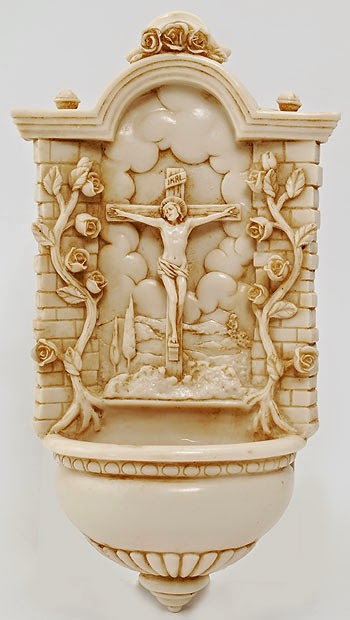
Holy Water font
4.  Holy Water. Catholics only.

Here the author did not even explain if or why holy water is a problem.  Why holy water?  Yeah, that's a difference, of sorts...

Here are some points on holy water:
--Water was used to ceremonially wash the body before entering the Temple in Jerusalem and it was a custom in the early Church as well.
--Holy water is used for baptism.
--Holy water fonts are available in Catholic Churches to remind us of our baptism and ceremonially cleanse us upon entering the nave (the main body of the Church).
--Catholics are sprinkled with water at certain Masses, reminding us of our baptism and our baptismal promises.
--On the altar, the priest pours a small amount of holy water in the chalice, indicating the water which came from the side of Christ along with His blood.
--The priest purifies his hands (ceremonially washes) before the Eucharistic prayers.
--It is a sacramental, not magic.

Fr. Morris, seen on TV
5. Celibacy and Nuns. Catholics only.

Celibacy was advocated by Christ and soon followed by the Early Church.
The disciples said to him, 'If that is how things are between husband and wife, it is advisable not to marry.' But he replied, 'It is not everyone who can accept what I have said, but only those to whom it is granted. There are eunuchs born so from their mother's womb, there are eunuchs made so by human agency and there are eunuchs who have made themselves so for the sake of the kingdom of Heaven. Let anyone accept this who can.'  (Matthew 19:10-12; emphasis mine)
The writings of the Church fathers show that, in the early Church, married priests were not the accepted norm in the main centres of Alexandria, Antioch and Rome. They were considered a "problem" that existed in the outlying regions. By the third century there were almost no married priests and several councils put the issue to rest until around the 9th century when many bishops and priests took wives and had children. The state of the priesthood fell to an all time low.  A huge problem emerged with priests "willing" Church property to their families. Up to that point, the principle of celibacy was never completely surrendered in the official enactments of the Church. In 1123, celibacy was made official. Although, throughout history there have been scattered instances of abuses of the Canon Law, the Roman Catholic Church has consistently stuck to this position on celibate priests.  (Catholic Bridge, "Why Can't priests get married?")
Ingrid Bergman in Bells of St. Mary's
In this day and age of clergy divorce, adultery, and "Preacher's daughters", the importance of singular dedication to God and their calling should be very apparent.  What some anti-Catholics do not understand is that there are married priests in the Catholic church.  Yes, they are the minority, but they do exist.  Celibacy is a discipline in order for priests and other religious to dedicate their whole lives to God without the distractions of spouse, children, and family responsibilities.  Men who become priests are responsible for a much bigger family--Christ's family.

In point of fact the Catholic Church is not the only church with nuns.  Both the Anglican church, and the Orthodox church have nuns, and the Lutheran church has "deaconesses".  I don't know much about Protestant nuns but Catholic nuns are women dedicated to Jesus Christ alone.  They spend their days praying for the salvation of the world and doing good (humanitarian) works.  This can only be a good thing.


6. Purgatory: Catholics only.

Yes and no.

Purgation  or Purgatory is not only Scriptural but traditional.

1030 All who die in God's grace and friendship, but still imperfectly purified, are indeed assured of their eternal salvation; but after death they undergo purification, so as to achieve the holiness necessary to enter the joy of heaven.
1031 The Church gives the name Purgatory to this final purification of the elect, which is entirely different from the punishment of the damned.  (Catechism of the Catholic Church)
Revelations 21:27 tells us that nothing impure will enter Heaven.

Purgatory is simply a place or state of being in which Christians are cleansed or purged of all stain of sin before entering Heaven.  It is neither a second chance, nor a place or state without hope.  Anyone who is in Purgatory or in the state of purging knows that they will be in Heaven once the cleansing is complete.  Since it is after this life, time does not exist there, so we cannot say that you spend a certain amount of "time" there because time doesn't exist there.

There are other Christian sects that believe in purification before Heaven but will not call this state or process Purgatory in opposition to the Church.  So, actually there are Protestant sects that do indeed believe in it, they just don't call it that.
  
7. Scripture: The be-all, end-all for Protestants is “the Word of God.” For Catholics, tradition is just important as scripture — maybe even more so.

What the blogger fails to point out is that Scripture is part of Catholic Tradition. It is the most important part of the Tradition of the Church.  It is extremely important to the Church and her members.

 "Therefore, the study of the sacred page should be the very soul of sacred theology. The ministry of the Word, too - pastoral preaching, catechetics and all forms of Christian instruction, among which the liturgical homily should hold pride of place - is healthily nourished and thrives in holiness through the Word of Scripture."  (CCC 132)
Protestantism that I have personally experienced has traditions of their own that is every bit as important as Scripture.  Scripture alone as the "be-all, end all" is a protestant tradition not based in Scripture.


One of my favorites for Children
8. Catechism: Protestant kids memorize the Bible. Catholic kids get catechism.

It is not quite as black and white as that.  The "catechism" that Catholic kids "get" includes Scripture.  While Catholic Children don't memorize large chunks of Scripture word for word, they learn whole sections and stories by heart.  Ask any Catholic kid about Creation, Moses,  the Prodigal Son, or the Wedding Feast at Cana, the Last Supper, or the Passion of Christ, I bet you'd be impressed.  The catechism is a concise outline of the Faith passed down for twenty centuries which includes Scripture.  Children learn their Faith and learn why the Church believes what it believes.  The Catechism, including the children's version, is filled with the rich gift of Scripture. While many Catholic children can't spout memorized Scripture on demand, properly catechized children can tell others about what is in the Bible and what we believe about it.


Vatican Council II
9. Authori-tay: In Catholicism, only the Roman Catholic Church has authority to interpret the Bible. Protestants hold that each individual has authority to interpret the Bible.

 Yes, the Church has the authority to interpret Scripture.  Christ sent the Holy Spirit to His Church at Pentecost for this very reason.  He guided and inspired men who wrote the Scriptures, who taught the Scriptures, and interpreted the Scriptures.  The Holy Spirit-guided Church gave the Bible as we know it to the world--even the Protestants.  And, there has been nearly 2,000 years of Catholic theologians, scholars, and councils studying and interpreting Scripture, why would an individual believe they've come up with something new?  That is the height of hubris.

The error of individual interpretation of Scripture is what gave us the "33,000!" (I'm quoting the blogger, now) different Protestant denominations, churches, or communities--however they want to distinguish or name themselves.  There are protestants fighting protestants.  Just one example would be the importance of baptism for salvation: one groups says it is necessary, others say you're just getting wet.


10. Sacraments: Catholic are the only ones to have the concept of the seven sacraments (baptism, confirmation, the Eucharist, penance, anointing of the sick, holy orders, and matrimony). Protestants teach that salvation is attained through faith alone.

Ironically, those that claim that their only authority is Scripture don't or won't understand that the only place that the words "faith alone" are found in Scripture, they appear in the negative.   

"So also faith of itself, if it does not have works, is dead." (James 2:17, NAB)
"Even so faith, if it hath not works, is dead, being alone." (James 2:17, KJV)
Faith produces fruit or it is dead, after all, "Thou believest that there is one God; thou doest well: the devils also believe, and tremble." (James 2:19, KJV)     

These sacraments are beneficial in the order of grace and all seven were instituted by Christ.  God's free gift of grace helps us with our faith, and our faith gets stronger with each sacrament we partake in.
The sacraments are efficacious signs of grace, instituted by Christ and entrusted to the Church, by which divine life is dispensed to us. The visible rites by which the sacraments are celebrated signify and make present the graces proper to each sacrament. (CCC 1131)

Mary, Mother of God
11. Holidays: Catholics have 10 Holy Days of Obligation (which mean they must go to Mass). Protestants are more like, “Just come to church on Christmas, that’s all we ask.”

This blanket statement is much too general.

Yes, the Catholic Church in America has 8 Holy days of Obligation (2 of the original 10, Epiphany and The Body and Blood of Christ, have been transferred to Sundays) in addition to our Sunday obligation.  The reality is that all Catholics are obligated to go to Mass every single Sunday of the year.  The other eight days are in addition to the Sunday obligation.

The Nativity (Christmas)
The ten (the eight with the other 2 now on Sunday) days are:  Mary, Mother of God (January 1), Epiphany (Sunday after January 1), Ascension (either the sixth Thursday of Easter or the seventh Sunday of Easter depending on the diocese), Body and Blood of Christ (Second Sunday after Pentecost), The Assumption of Mary (August 15), All Saints (November 1), Immaculate Conception of Mary (December 8) and Christmas Day (December 25).

As for Protestants, I don't agree with the blogger's blanket statement.  In the Baptist church in which I grew up, it was expected, if not an outright rule, that all good members of that church went to church on Sunday morning, Sunday evening, and Wednesday evenings.  Also expected was attendance to any "revivals" and extra prayer meetings.  You were told in the minister's message how you couldn't be a good Christian if you didn't give time and money to God.  I'm sure that this "obligation" is still true in many Protestant churches today.
 
The Eucharist and Heaven
12. Communion: In Catholicism, the bread and wine “become” the body and blood of Jesus Christ, meaning that Jesus is truly present on the altar. In Protestantism, the bread and wine are symbolic.

While true, this is a broad generalization.  The Catholic Church does believe in the Real Presence of Christ in the Eucharist.  The main reason is because we believe Christ words literally.  We believe He meant what He said:

Then he took bread, ...saying, 'This is my body given for you'...He did the same with the cup after supper, and said, 'This cup is the new covenant in my blood poured out for you.' (Luke 22:19,20)
Jesus took bread, said the blessing, broke it, and giving it to his disciples said, “Take and eat; this is my body.” Then he took a cup, gave thanks, and gave it to them, saying, “Drink from it, all of you, for this is my blood of the covenant, which will be shed on behalf of many for the forgiveness of sins." (Matthew 26:26-28)
Also, in the Orthodox and Lutheran traditions the bread and wine are more than symbolic, but expressed in a different way than the Catholic Church.

I, personally, feel sorry for Protestants who claim they believe in what Scriptures say, yet ignore what Scripture actually says.  If communion is just bread and wine (actually grape juice in most Protestants circles), what was the point of doing it in the first place?  Just going through the motions seems a lot less efficacious than believing in Christ's words.  

Conclusion: Christians have a lot more commonality than differences.  We all are sincerely trying to follow Christ and His teaching. Our Lord taught us to love God and love one another. Do I think Protestants are wrong on many levels?  Yes or I would not be a Catholic today.  I have found Christ, His Church, His family.  I am completely in love with my Savior and I believe that I am doing my best to follow Him and help my children know and follow Him.  Other Christians waste a lot of time, money, effort, and hatred on fellow Christians.  It is sad, really, because that is not what Christ intended. We are all God's children and we all deserve respect.

Feast of the Assumption

 The Feast of the Assumption of the Blessed Virgin Mary - another example of "not-so-ordinary" days! These are COUNTING days - and...