Showing posts with label Epiphany. Show all posts

Epiphany Door Chalk Blessing

With Epiphany comes the tradition of marking the entry door to your home with blessed chalk. Typically your parish will have some blessed chalk available, or you can bring some and have your priest bless it.

The initials C+M+B are surrounded by the current year, for example, this year it is 20 C+M+B 23.

The initials have 2 different meanings, 

1) The names of the 3 Wisemen: Caspar, Malchior, and Balthazar.

2) In Latin the phrase, Christus mansionem benedicat: “May Christ bless the house.”

The plus signs (+) represent the Cross.

The tradition is centuries old (still looking for a more precise date) and has its roots in Exodus where it is prefigured by the marking of the doors by the Israelites while they were in captivity in Egypt. In the prefigurement, they were passed over by the Angel of Death (Passover) and in the modern tradition we pray for blessings on our home and all who enter it.  

The blessing of your door should take place sometime on or about the Feast of Epiphany (February 6th, or the Sunday after February 6th) and can be done at any time during the Season of Epiphany, which lasts up till Ash Wednesday - and the start of Lent.

Prayers for the blessing of the door:

On entering the home,

Leader(Priest, if present, or father of the family) : Peace be to this house.
All: And to all who dwell herein.

All: From the east came the Magi to Bethlehem to adore the Lord; and opening their treasures they offered precious gifts: gold for the great King, incense for the true God, and myrrh in symbol of His burial.

All Pray: The Magnificat. During the Magnificat, the room is sprinkled with holy water and incensed. After this is completed,

All: From the east came the Magi to Bethlehem to adore the Lord; and opening their treasures they offered precious gifts: gold for the great King, incense for the true God, and myrrh in symbol of His burial.

Leader: Our Father. . .
And lead us not into temptation

All: But deliver us from evil.
Leader: All they from Saba shall come
All: Bringing gold and frankincense.
Leader: O Lord, hear my prayer.
All: And let my cry come to You.

Leader: Let us pray. O God, who by the guidance of a star didst on this day manifest Thine only-begotten Son to the Gentiles, mercifully grant that we who know Thee by faith may also attain the vision of Thy glorious majesty. Through Christ our Lord.

All: Amen.

Leader: Be enlightened, be enlightened, O Jerusalem, for thy light is come, and the glory of the Lord is risen upon thee—Jesus Christ born of the Virgin Mary.

All: And the Gentiles shall walk in thy light and kings in the splendor of thy rising, and the glory of the Lord has risen upon thee.

Leader: Let us pray.
Bless, + O Lord God almighty, this home, that in it there may be health, purity, the strength of victory, humility, goodness and mercy, the fulfillment of Thy law, the thanksgiving to God the Father and to the Son and to the Holy Spirit. And may this blessing remain upon this home and upon all who dwell herein. Through Christ our Lord.

All: Amen.

After the prayers of the blessing are recited, each room of the home is sprinkled with Epiphany water and incensed. The initials of the Magi are inscribed upon the doors with the blessed chalk. (The initials, C, M, B, can also be interpreted as the Latin phrase “Christus mansionem benedicat” which means “Christ bless this house”.)  

(Source:https://onepeterfive.com/the-chalking-of-the-doors-an-epiphany-tradition-explained/)

Another prayer:

May all who come to our home this year rejoice to find Christ living among us; and may we seek and serve, in everyone we meet, that same Jesus who is your incarnate Word, now and forever. Amen.

God of heaven and earth, you revealed your only-begotten One to every nation by the guidance of a star. Bless this house and all who inhabit it. Fill us with the light of Christ, that our concern for others may reflect your love. We ask this through Christ our Saviour. Amen.

Loving God, bless this household. May we be blessed with health, goodness of heart, gentleness, and abiding in your will. We ask this through Christ our Saviour. Amen.

(Source:https://onepeterfive.com/the-chalking-of-the-doors-an-epiphany-tradition-explained/)

It Is Now The Season of Epiphany

EPIPHANY!

Epiphany has begun! Traditionally this is the celebration of the arrival of the Three Wise Men from the East. Though just 13 days after the ChristMass, the celebration of the birth of Jesus, they more likely showed up a year or two later. This is witnessed by the Slaughter of the Innocents, the First Christian Martyrs, as when Herod ordered the slaughter, it was not just for the infants and young babies, but for any male child two years old and younger:

Matthew 2:16 - Then Herod perceiving that he was deluded by the wise men, was exceeding angry; and sending killed all the male children that were in Bethlehem, and in all the borders thereof, from two years old and under, according to the time which he had diligently inquired of the wise men.

The feast day for the Holy Innocents is December 28th for most of Christendom. Eastern Orthodox celebrate on December 29th, and the East Syrians on January 10th. 

This is actually a period of dual seasons, as Christmastide runs through Candlemas, the celebration of the Presentation of Jesus at the Temple. Epiphany takes us all the way to Lent.

Happy Epiphany - One Last Time!


Yes, it is STILL the ordinal (counting) time after Epiphany - through today! Tomorrow begins Septuagesima. It seems like Christmas was just here - and in a sense, it was just ten days ago. Christmastide ended on Candlemas (Feb. 2nd) and today is the last day we have reference to the Christchild. In some traditions, Christmastide lasts all the way through the ordinal weeks of Epiphany.

Septuagesima is a preparatory time for Lent. While it is still recognized and celebrated in the Extraordinary Rite, the Ordinary Rite no longer does. For the Ordinary Rite, tomorrow is the 6th Sunday in Ordinary Time. The Church needs her special seasons - and not just "ordinary time." Knowing the season helps keep us focused on Christ and His Church.

Some ask "Why do we call it Septuagesima, which means "70" when there are only 63 days until the end of Lent?" Fr. Zuhlsdorf answers succinctly: 

These Sundays of Septuagesima, Sexagesima and Quinquagesima, before Lent or Quadragesima begins, are rough estimates but within certain parameters.

    • Septuagesima is the 63rd day before the Triduum and, therefore, is in the 7th decade or 10-day period before Easter (61st to 70th days),
    • Sexagesima Sunday is the 56th before, in the 6th decade (51st to 60th),
    • Quinquagesima is the 49th day, 5th decade (41st to 50th) days before the Triduum.
    • Quoted from: https://onepeterfive.com/septuagesima-sunday/

Prepare ye the way of the Lord, make straight His path.

AMDG,

Scott<<<

Merry Little Christmas


Epiphany Season!

January 6th begins Epiphany and we are now into the first ordinal (counting) season of the liturgical year. I like to point out this time is NOT "ordinary" - it is "ordinal." Regardless of the missalette calling it "ordinary" the connotation is nothing special, when it is still a special season!
 
Epiphany is also known as "Little Christmas." So, have yourself a merry Little Christmas now! (sorry, couldn't resist!)

It Is Still Christmastide!

Even though we are into Epiphany, there is an overlap here! Christmastide lasts all the way to Candlemas, which is February 2nd - so Merry Christmas!

Christmastide Has Begun!


 Let us not forget - Christmas has JUST BEGUN! Not only the "12 Days of Christmas" - from Christmas Day to Epiphany (December 25-January 5th, January 6th is Epiphany). AND - even though the Season of Epiphany begins on January 6th - Christmastide lasts through Candlemas, February 2nd! 

So - MERRY CHRISTMAS! And do not be ashamed to keep wishing one another that through February 2nd! It can even be an ice-breaker for you to engage others in not only the true meaning of Christmas, but also the reality of how long the season lasts - AND that it did not even begin until Christmas Day - the weeks prior were a different season - the Season of Advent - a penitential season, similar to Lent, but not as severe, and a time of preparation for the coming of the Lord.

Many of the lessons in Advent are not about the Nativity, but the Second Coming of Jesus - which brings into focus the REAL meaning behind WHY God became Man to redeem us from our sin.

And also remember to keep Christ in Christmas - you have to keep the Mass in Christmass (spelled this way on purpose!). 


Epiphany

Epiphany, the celebration of the arrival of the "Three Wise Men" from the East. They came bearing gifts for the Christchild. In many Catholic traditions, gifts are given on this day instead of (or on top of) December 25th. It is also a time of reflecting not only on the Infant Jesus, but also upon the baptism of Jesus - when He is revealed by God - and the Trinity is physically present as the Father announces His Son, and the Holy Ghost descends upon Him as a dove. 


The letters C, M, B have two meanings:
• They are the initials of the traditional names of the three magi: Caspar, Melchior, and Balthazar.
• They also abbreviate the Latin words Christus Mansionem Benedicat, “May Christ bless this house.”

The “+” signs represent the cross and 2021 is the year.

After the chalking of your front door, a blessing should be said. Here is a suggestion from the Carmelites website:

All make the Sign of the Cross.

In the name of the Father, and the Son and the Holy Spirit. Amen

Leader: Peace be to this house and to all who dwell here, in the name of the Lord.

All: Thanks be to God.


Merry Christmas!

Yes!  Merry Christmas!  Tonight is Twelfth Night!  
Tomorrow is Epiphany Sunday, January 6th.

 When Does Christmas End?
The Christmas Season, traditionally, has at least a couple different ending dates. One thing is clear, Christmas is NOT over on December 26th! It was actually considered "bad luck" to take down ones Christmas decorations before the season actually ended. So when DOES the Christmas Season end?

January 5th - Twelfth Night

January 6th is Epiphany, which comes from the Greek "to reveal." It is the day celebrated as when the Three Wise Men (or Three Kings) arrived to see the newborn King, Jesus Christ. This is the more recent ending of the Christmas Season as January 6th begins the Season of Epiphany. Epiphany lasts until "Fat Tuesday" for the following day is Ash Wednesday, and Lent officially begins.

February 2nd - Candlemas 

It is at Candlemas (The Feast of the Presentation of Christ at the Temple) in the lectionary where the Nativity is mentioned for the last time in the liturgical year. This is the last day of Christmastide. Our priest, last Sunday, made a distinction between Christmas Season, which ends with Twelfth Night, and Christmastide, which ends with Candlemas.

Poet, Robert Herrick (1591-1674) wrote the following poem commemorating the day to take down the Christmas decorations entitled Candlemas Eve:

Candlemas Eve

Down with the rosemary and bays,
Down with the misletoe;
Instead of holly, now up-raise
The greener box, for show.   
 
The holly hitherto did sway;
Let box now domineer,
Until the dancing Easter-day,
Or Easter’s eve appear.   
 
Then youthful box, which now hath grace
Your houses to renew,
Grown old, surrender must his place
Unto the crispèd yew.

When yew is out, then birch comes in,
And many flowers beside,
Both of a fresh and fragrant kin,
To honour Whitsuntide.   

Green rushes then, and sweetest bents,
With cooler oaken boughs,
Come in for comely ornaments,
To re-adorn the house.

Thus times do shift; 
Each thing his turn does hold;
New things succeed,
As former things grow old.

The poem takes us from Christmastide, taking down our Christmas decorations, to Easter and then Pentecost (Whitsunday) and into summertime - and back to when "cooler oaken boughs..." and it is time again to re-adorn the house for the next Christ Mass celebration.


Christmas Has Begun!

Advent is over and the Season of the Christ Mass is upon us!  Don't go tearing down your tree, ornaments and lights just yet!  Christmas has JUST BEGUN!  Traditionally Christmas lasts until at least Epiphany, January 6th, which is the day we celebrate the Three Wise Men arriving to greet the newborn King and they came bearing gifts... perhaps the first gifts of Christmas which started the whole gift giving tradition!  

An even more ancient tradition has the final day of the Christmas Season as February 2nd, Candlemas (or Candle Mass).  This is the recognition of Mary fulfilling the Jewish requirement of purification (not that she "needed" it) and in the readings for Mass this day is the last mentioning of the Christ Mass for this liturgical year - Christmas is over.

So, continue to celebrate the Christ Mass!  Raise a few eye-brows and wish someone a "Merry Christmas" and when they try to correct you - you have an opportunity to gently correct them and remind them that Advent ended on December 24th, Christmas just began on that day!

And, as our on-going campaign states...  "The best way to keep Christ in Christmas is to keep Mass in Christmas!"  Please share this page and/or the memes below - and MERRY CHRISTMAS!


The Twelfth Day of Christmas!

Well, today ends the Christmas Season - sort of.  Today was the Twelfth Day of Christmas and tomorrow starts the Season of Epiphany.  I say "sort of" because as we've mentioned earlier, in some traditions the Christmas Season lasts all the way to February 2nd, Candlemas.  In the traditional readings for Candlemas we have the last mentioning of Christmas for this liturgical year.  So, if you really want to keep your decorations up a bit longer - you can!  Some of your friends might think you're a little crazy (maybe you are!) but you can also use this as an ice-breaker to discuss your faith with them and while the liturgical season switches to Epiphany, Epiphany is still a celebration of the Christ child - so one really could celebrate Christmas all the way until Lent begins!

So....

MERRY CHRISTMAS!


Ordinal Time

Should we really call it "Ordinary Time?"  This coming Sunday will mark the "First Sunday After Epiphany" according to the Traditional (Extraordinary) lectionary, but most will call it "The First Sunday in Ordinary Time."  I ask, what is so "ordinary" about this time?  Why do we call this "Ordinary Time?"

Well, first off the title of "Ordinary Time" is misleading, as it comes from "Ordinal Time" - which means "counting time."  The main point I'd like to bring out is that in "counting" we're constantly reminded of the weeks after a given holy day, in this case it is Epiphany (later in the year it is Pentecost).  Let us continue to remember the holy day and that it is the "Season after Epiphany."  This is not an "ordinary" season in the way most English speaking people understand the terminology of "ordinary."  Yes, both come from the same root word, but "ordinal" implies the true nature of the season as counting days after a given holy day.  For the next several weeks I urge you to continue to remember the coming of the Three Wise Men from the East - and why they sought out our Lord and Savior over the birth of anyone else born in a royal heritage.  There are so many reasons for us to remember this day of their arrival, the homage they paid and the fact that they were given a sign in a vision to leave by another route, and not go back to King Herod.  As Bp. Sheen once said, "all who visit our Lord leave differently."

This is also an opportune time to remind everyone that in certain traditions Christmas itself is not "over" yet, and lasts until Candlemas in which it is the last time that the Nativity of Our Lord is mentioned in the readings of the Mass.  Candlemas falls on February 2nd.

12th Night (Twelfth Night)

Tonight marks the end of the 12 Days of Christmas, tonight is "Twelfth Night."  Tomorrow begins the Season of Epiphany which directly precedes the Season of Lent.  In many traditions the celebration of 12th Night symbolizes the close of the Christmas Season.  Decorations were taken down and the wreath which hung upon most Christian doors would be removed and any edible parts of it were eaten.  There is also the tradition of the "King's Cake" - which would be prepared and eaten on 12th Night.  The King's Cake is a round/ring cake (sometimes with a crown in the middle).

Epiphany marks the day the Wise Men arrived to visit the Infant Jesus, and they came bearing gifts.  This is one of the reasons we give gifts in the Christmas Season, though most have moved this celebration of gift giving to Christmas morning.  One tradition, as the song of the Twelve Days of Christmas portrays, is to give a gift on each day of the 12 days.

What will you do to celebrate this evening?  Bake a King's Cake?  Exchange gifts?  If you've never marked this holy day (holiday) then perhaps this year is a good year to start!

Blessings and Merry Christmas!  (Yes, today is STILL part of the Christmas Season!)

Merry Christmas or Happy Holidays?

Should We Be Offended By Happy Holidays?

My answer is NO!  The person, regardless of whether they are aware or not, is actually wishing you have happy HOLY DAYS!  That would actually be the PREFERRED GREETING prior to Christmas Day!  Why?  Because prior to Christmas Day it's NOT CHRISTMAS YET!  The season prior to the Christmas Season is Advent, not Christmas.  Advent is a time of anticipation and penance - it is NOT "Christmas."  The Christmas Season starts with Christmas Day, and then we have the "Twelve Days of Christmas" which run from December 25th through January 5th.  January 6th starts the NEXT season in the liturgical year, and that is the Season of Epiphany!  Some traditions include Epiphany with Christmas extending to "Candlemas" - which traditionally is the celebration of the Presentation of Jesus at the Temple.  It is celebrated the Sunday closest to February 2nd.

How About "Merry X-Mass?"

Well, here again, NO!  The "X" is traditionally a Christian symbol for Christ!  So, in reality, they have not "removed" Christ from Christmas in using X-mas! 

Be Joyful!  Celebrate Christ!

It is my opinion that we should not get all caught up in negativity.  The world has far too much of that as it is.  Let us see joy and hope, especially in this season of Christmas!  Consider how your words and actions appear to others.  Are you presenting a good Christian face to the world?  Or, are you presenting a Scrooge-like face (prior to his epiphany)?  Think about it and BE HAPPY!

Merry Christmas to all and peace to men of good will.

Epiphany 2012

With today being Epiphany and the Twelfth Day of Christmas, Christmas is over for many traditions.  I say "many" because some still celebrate the Holiday through Candlemas - Feb. 2nd.  

The Solemnity of the Epiphany is what we call it in the Latin Church, in the Eastern traditions it is called "Theophany" and is one of the oldest Christian feast days celebrated - and has, from the earliest dates, been celebrated on January 6th.

Originally Epiphany/Theophany actually celebrated four different feasts:  The Baptism of our Lord, the First Miracle of our Lord at Cana, The Nativity of our Lord and the arrival of the "Three Kings" or "Three Wisemen."  Eventually in the West, the celebration of the Nativity became the celebration of the Christ Mass, or Christmas, on December 25th.  In many parts of the world the tradition of giving gifts, like the Wise Men, is practiced on Epiphany.

Did I mention this is a "solemnity?"  Being that this solemnity which falls on a Friday - for all you Catholics who observe Canon Law (which should be ALL of you!) you don't have to offer up your Friday Penance (which traditionally is the abstaining from meat)!  Yes, it is STILL a mortal sin to NOT observe SOME sort of penance EVERY FRIDAY THROUGHOUT THE YEAR - EXCEPT when a solemnity falls on a Friday (just as every Sunday is a solemnity, no penance is required on solemnities).  Please see the articles I wrote on this earlier (click here or here for another one).

Dreikönigstag! Theophany! Epiphany!

Dreikönigstag is German for "Three Kings Day!"

Theophany is from the Greek and means "The Appearance of God"

It is Epiphany!  Epiphany is also from Greek and means "appearance" or "manifestation."

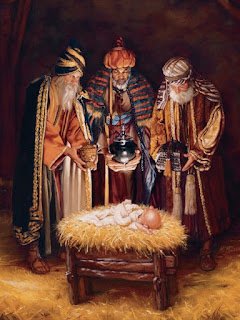
Today is the day we celebrate the Magi/Kings visitation to the Baby Jesus (in many Catholic diocese this feast gets moved to a Sunday between January 2nd and 8th).  The Magi came bearing gifts of gold, frankincense and myrrh.  It can also be argued that the tradition of giving gifts at Christmas started with the Magi/Kings.

Symbolism in the Magi and the Gifts

The Magi, being "from the East," represents the Gentiles, who too would become part of God's Chosen People, as John 12:32 tells us that when He is lifted up He will draw all to Him.  The day we celebrate as the "manifestation of God" is the day the Magi found Him, worshiped and adored Him.  The Gentiles would be among the first to acknowledge Him for who He is.

Gold:  A gift of honor worthy of royalty.  The Magi recognize the royal kingship of Israel's newborn King.

Frankincense: Often used as incense or perfume - it was also used in sacrifices for God to send a sweet smell to God on high.  The Magi recognize the sacrificial nature of this King.

Myrrh:  Myrrh is used for the holy anointing of prophets, but it is also a burial spice representing mortality, suffering and sorrow.


Further Reading:
http://www.chrysaliscafe.com/2007/12/symbolism-of-gifts-of-magi.html
http://www.therealpresence.org/archives/Sacred_Scripture/Sacred_Scripture_004.htm
http://allsaintstaylorsville.blogspot.com/2011/01/gifts-of-magi.html
http://www.suite101.com/content/wise-men-bearing-gifts-a323325

Twelve Drummers Drumming!

So, today is the Last Day of the Twelve Days Christmas!  Tonight is "Twelfth Night" which traditionally has been an evening of celebration, drinking of "wassail" punch and the taking down of Christmas decorations, trees, wreaths, etc.  Often trees and wreaths were decorated with fresh fruit, which is a bit scarce around Christmas time in the northern hemisphere, so part of the festivities included eating of the fruit.

There is some controversy over just which day is the Twelfth Day of Christmas.  In Medieval times the tradition of marking the start of the day was sunset (which is also a carry-over from Hebrew tradition, long before Medieval days).  In that tradition "Twelfth Night" actually came before "Twelfth Day."  Thus, January 6th would be the "Twelfth Day" but January 5th marked the "Twelfth Night."  Twelfth Night was the day to have the "Twelfth Night Party" since sunset on January 6th would then mark the start of Epiphany.  In modern times we mark the beginning of Christmas with the "Midnight Mass" which is when Christmas Day begins on the calendar (12:01am - is Christmas Day).  So counting Christmas Day as the "First Day of Christmas" - takes us to January 5th as the "Twelfth Day of Christmas" and January 6th marks the "First Day of Epiphany."

Is Christmas Over?

For many, January 5th marks the end of the Christmas Season and the beginning of Epiphany - however - in some traditions it is still "Christmastide" until the Candlemas - which is the Feast of The Presentation of Christ at the Temple, on February 2nd (sometimes moved to a nearby Sunday for celebration).  So, if you want to recognize Christmas longer - feel free to embrace this tradition!

Liturgically Speaking

If we base our counting on the Liturgical Year here is how we would follow the seasons:
Season 1:  Advent (beginning 4 Sundays prior to December 25th)
Season 2:  Christmas (Begins with Midnight Mass on December 25th)
Season 3:  Epiphany (January 6th)
Season 4:  Ordinal (Counting) Time (Sundays after Epiphany until Lent begins)
Season 5:  Lent (40 days prior to Easter Sunday, not counting the Sundays, begins on Ash Wednesday)

Happy New Year?

Well January 1st is when most of the Western world celebrates the "New Year" but for Catholics we're already almost to our third liturgical season of the New Year!  Advent is over, Christmas is about three fourths complete, and Epiphany begins on January 6th!

Today is the Tenth Day of Christmas!  So Merry Christmas!  Wednesday will make it "Twelfth Night" and that is the Epiphany Eve.

Merry Christmas and peace on earth to men of goodwill!

Scott<<<

PS- Now here's a thought!  One would THINK that if the commercial marketing outlets catch on to this - they too would support the "Twelve Days of Christmas!"  Just think!  That's TWELVE DAYS of giving instead of just ONE!  Oh, they could still (and likely would) have all the build-up to the First Day of Christmas - but if they extended the concept (as it has long BEEN the concept in Christendom) of the TWELVE DAYS - think of how we could also use that to remind people of the Christchild, for why He came - AND that He's coming again!

PPS- One drawback... traditionally there's still only ONE day of giving, and that is on Epiphany - the celebration of the Three Kings arrival at the manger when they came bearing gifts at the conclusion of that First Christmas Season.

Feast of the Assumption

 The Feast of the Assumption of the Blessed Virgin Mary - another example of "not-so-ordinary" days! These are COUNTING days - and...