Showing posts with label Immaculate Conception. Show all posts

Consecration of Russia to the Immaculate Heart - Friday

This Friday, March 25th, on the Solemnity of the Annunciation, Pope Francis has asked the world to unite with him at 6:30pm, Rome time,  in praying for the consecration of Russia along with Ukraine to the Immaculate Heart of Mary. The time to pray: 

6:30 p.m. Rome

5:30 p.m. — GMT (London)

1:30 p.m. — Eastern Time (New York, Washington, Miami)

12:30 p.m. — Central Time (Chicago, St. Louis, Dallas)

11:30 a.m. — Mountain Time (Denver, Salt Lake City)

10:30 a.m. — Pacific Time (Arizona - MST, Los Angeles, Seattle)

https://www.catholicnewsagency.com/news/250786/what-time-is-the-consecration-of-russia-and-ukraine-find-out-here 

Now is not the time to debate whether or not this is the fulfillment of what Sr. Lucia said the Blessed Mother at Fatima had requested. Some believe it has already happened while other say it never did. We can discuss all this later. For now - pray for peace in Ukraine and pray that Russia is consecrated to the Immaculate Heart of Mary. 

The text of the prayers:

O Mary, Mother of God and our Mother, in this time of trial we turn to you. As our Mother, you love us and know us: no concern of our hearts is hidden from you. Mother of mercy, how often we have experienced your watchful care and your peaceful presence! You never cease to guide us to Jesus, the Prince of Peace.

Yet we have strayed from that path of peace. We have forgotten the lesson learned from the tragedies of the last century, the sacrifice of the millions who fell in two world wars. We have disregarded the commitments we made as a community of nations. We have betrayed peoples’ dreams of peace and the hopes of the young. We grew sick with greed, we thought only of our own nations and their interests, we grew indifferent and caught up in our selfish needs and concerns. We chose to ignore God, to be satisfied with our illusions, to grow arrogant and aggressive, to suppress innocent lives and to stockpile weapons. We stopped being our neighbour’s keepers and stewards of our common home. We have ravaged the garden of the earth with war and by our sins we have broken the heart of our heavenly Father, who desires us to be brothers and sisters. We grew indifferent to everyone and everything except ourselves. Now with shame we cry out: Forgive us, Lord!

Holy Mother, amid the misery of our sinfulness, amid our struggles and weaknesses, amid the mystery of iniquity that is evil and war, you remind us that God never abandons us, but continues to look upon us with love, ever ready to forgive us and raise us up to new life. He has given you to us and made your Immaculate Heart a refuge for the Church and for all humanity. By God’s gracious will, you are ever with us; even in the most troubled moments of our history, you are there to guide us with tender love.

We now turn to you and knock at the door of your heart. We are your beloved children. In every age you make yourself known to us, calling us to conversion. At this dark hour, help us and grant us your comfort. Say to us once more: “Am I not here, I who am your Mother?” You are able to untie the knots of our hearts and of our times. In you we place our trust. We are confident that, especially in moments of trial, you will not be deaf to our supplication and will come to our aid.

That is what you did at Cana in Galilee, when you interceded with Jesus and he worked the first of his signs. To preserve the joy of the wedding feast, you said to him: “They have no wine” (Jn 2:3). Now, O Mother, repeat those words and that prayer, for in our own day we have run out of the wine of hope, joy has fled, fraternity has faded. We have forgotten our humanity and squandered the gift of peace. We opened our hearts to violence and destructiveness. How greatly we need your maternal help!

Therefore, O Mother, hear our prayer.

Star of the Sea, do not let us be shipwrecked in the tempest of war.

Ark of the New Covenant, inspire projects and paths of reconciliation.

Queen of Heaven, restore God’s peace to the world.

Eliminate hatred and the thirst for revenge, and teach us forgiveness.

Free us from war, protect our world from the menace of nuclear weapons.

Queen of the Rosary, make us realize our need to pray and to love.

Queen of the Human Family, show people the path of fraternity.

Queen of Peace, obtain peace for our world.

O Mother, may your sorrowful plea stir our hardened hearts. May the tears you shed for us make this valley parched by our hatred blossom anew. Amid the thunder of weapons, may your prayer turn our thoughts to peace. May your maternal touch soothe those who suffer and flee from the rain of bombs. May your motherly embrace comfort those forced to leave their homes and their native land. May your Sorrowful Heart move us to compassion and inspire us to open our doors and to care for our brothers and sisters who are injured and cast aside.

Holy Mother of God, as you stood beneath the cross, Jesus, seeing the disciple at your side, said: “Behold your son” (Jn 19:26.) In this way he entrusted each of us to you. To the disciple, and to each of us, he said: “Behold, your Mother” (v. 27). Mother Mary, we now desire to welcome you into our lives and our history. At this hour, a weary and distraught humanity stands with you beneath the cross, needing to entrust itself to you and, through you, to consecrate itself to Christ. The people of Ukraine and Russia, who venerate you with great love, now turn to you, even as your heart beats with compassion for them and for all those peoples decimated by war, hunger, injustice and poverty.

Therefore, Mother of God and our Mother, to your Immaculate Heart we solemnly entrust and consecrate ourselves, the Church and all humanity, especially Russia and Ukraine. Accept this act that we carry out with confidence and love. Grant that war may end and peace spread throughout the world. The “Fiat” that arose from your heart opened the doors of history to the Prince of Peace. We trust that, through your heart, peace will dawn once more. To you we consecrate the future of the whole human family, the needs and expectations of every people, the anxieties and hopes of the world.

Through your intercession, may God’s mercy be poured out on the earth and the gentle rhythm of peace return to mark our days. Our Lady of the “Fiat," on whom the Holy Spirit descended, restore among us the harmony that comes from God. May you, our “living fountain of hope,” water the dryness of our hearts. In your womb Jesus took flesh; help us to foster the growth of communion. You once trod the streets of our world; lead us now on the paths of peace. 

Amen.

Feast of the Immaculate Conception

In 2019 the Second Sunday of Advent (December 8th) is also the Feast of the Immaculate Conception (IC). The celebration of the IC supersedes the Second Sunday of Advent in the Mass for this day. It still IS the Second Sunday in Advent and the week following is still the second week of the Advent Season (again, this is NOT the Christmas Season... yet).
 
Theotokos with her parents, Sts. Joachim and Anna.

Many still think the Immaculate Conception refers to Jesus' conception (which is actually celebrated on March 25th) but this is the day we celebrate the Immaculate Conception of the Blessed Virgin Mary. 

Mary, according to the dogmatic definition (no faithful Catholic can deny this) was, from the very moment of her conception, preserved from the stain of Original Sin. The wording from Ineffabilis Deus:
We declare, pronounce, and define that the doctrine which holds that the most Blessed Virgin Mary, in the first instance of her conception, by a singular grace and privilege granted by Almighty God, in view of the merits of Jesus Christ, the Savior of the human race, was preserved free from all stain of original sin, is a doctrine revealed by God and therefore to be believed firmly and constantly by all the faithful. 
https://www.americancatholictruthsociety.com/docs/pix_ineffabilis_deus.htm

There is a stern warning to any Catholic who would deny this teaching:
Hence, if anyone shall dare -- which God forbid! -- to think otherwise than as has been defined by us, let him know and understand that he is condemned by his own judgment; that he has suffered shipwreck in the faith; that he has separated from the unity of the Church; and that, furthermore, by his own action he incurs the penalties established by law if he should dare to express in words or writing or by any other outward means the errors he thinks in his heart. (ibid)

Again, this still IS the Second Sunday in Advent - so don't forget to light that second violet candle!

Blessed Advent, my friends!

Please share!


December 8 - Solemnity of the Immaculate Conception


The Immaculate Conception of the Blessed Virgin Mary. 


For a long time as a Protestant, and even up until I think my first celebration of the Solemnity of the Immaculate Conception - I was under the impression that this referred to the conception of Jesus! Au contrare, mon ami!  This day commemorates the conception of the Blessed Virgin Mary in the womb of her mother, St. Anne. It is a miraculous event because at the very moment of her conception she was given a special grace - to be spared from the stain of Original Sin. This fact was defined, infallibly, by Pope Pius IX in 1854 in a sentence from the papal bull, Ineffabils Deus:
We declare, pronounce, and define that the doctrine which holds that the most Blessed Virgin Mary, in the first instance of her conception, by a singular grace and privilege granted by Almighty God, in view of the merits of Jesus Christ, the Savior of the human race, was preserved free from all stain of original sin, is a doctrine revealed by God and therefore to be believed firmly and constantly by all the faithful. (Source).
Something else that I, as a Protestant, did not realize is that the entire papal bull is not wholey infallible - just that sentence! Just where the definition is made is considered infallible, not the whole document. That was yet another common misconception of Protestants and goes along with the thinking, "Catholics believe popes are infallible." Which can be a true statement, but in actuality, Catholics only believe a pope is infallible when he speaks "ex cathedra" - that is, "from the Chair" (of St. Peter).

Why do Catholics make such a big deal of Mary?

Well, she IS a big deal!  Much in the same manner of how sin first entered the world through a woman, Eve; Mary is considered "The Second Eve" - in that through her and her fiat, the redemption of the whole world is made possible. We commemorate this with every "Hail Mary" we pray. Keep in mind, the "Hail Mary" comes straight from Scripture! 
Luke 1:28 - And the angel (Gabriel) being come in, said unto her: Hail, (Mary), full of grace, the Lord is with thee: blessed art thou among women.Luke 1:42 - And she cried out with a loud voice, and said: Blessed art thou among women, and blessed is the fruit of thy womb (Jesus).
Again, as a Protestant, I was not aware of how scriptural the "Hail Mary" prayer is.

What does it mean to be free from the stain of Original Sin?

As we have already said, and most Christians agree with, sin entered the world initially through the act of a woman, Eve, and we call this the Original Sin. Every human being, save four (Adam, Eve, Mary and Jesus) are born with this fallen nature - a stain upon their soul. This fallen nature is enough to keep us from entering into Heaven - for nothing impure can enter there (Rev. 21:27). Making each and every one of us in need of a Savior, a Redeemer, who would make it possible to have every stain of sin washed away.

Mary was preserved from this stain for she was chosen, by God, to be the Ark of the New Covenant, the God-Bearer, the one who was given the singular honor to be the "Mother of our Lord" (Luke 1:43). Being this vessel to carry our Lord and God within her, she was given this gift of having not even the stain of Original Sin.

Being preserved from the stain of Original Sin does not mean she was preserved from the penalty of Original Sin - which is physical death. There is some room for debate here because, again, this is not part of the definition of the Immaculate Conception. Did she die or did she merely fall asleep (the Dormition, as our Eastern Catholics and Orthodox refer to the Assumption of the Blessed Virgin). This will be the topic for another blog entry (and has been) for August 15th.

Questions For Catholics Part 1

With a little prompting from my priest, I am beginning a series of responses to Moriel Ministries which has presented "Five Questions for Catholics," however the article title says the number is thirty-three and perhaps through secondary questions they reach the higher number, but the inconsistency is noted upfront.


Who is this?  James Jacob Prasch (Jacob Prasch) was raised in a mixed household of Catholic and Jewish.  He states he was "forced" to attend Catholic school as a youth, but also attending the Jewish Community Center.  This left him agnostic and in college while he was attempting to use science to disprove Christianity but came to the conclusion that it took more faith to reject Jesus and the Bible than to accept it.  Subscribing to Marxism and the "hippee culture" and nearly subcombing to drugs, he hit bottom and "put his faith in Jesus."  He and Moriel (have not found more about Moriel on the site which bares his name) got together in Moriel Ministries, which Prasch is now the director.

Without further ado, let us proceed into the series of questions presented to Catholics. 

https://www.moriel.org/questions/questions-for-catholics.html

The first question we come to on Moriel's homepage is "Should I believe Mary or the Vatican?"
Without doubt Mary – her real name was “Miryam” – Mary the mother of Jesus was the greatest woman who ever lived.
The angel Gabriel. the archangel “Gabriy’el”, “the mighty one of God” appeared to her and told her that God Himself would become incarnate inside of her, she would be the mother of the Messiah, the Savior, who would save His people from their sin. This is the greatest woman who ever lived. And the greatest woman who ever lived, who has ever lived, was told she’s going to be the mother of the Savior who would save His people from their sin in the Magnificat in St. Luke’s Gospel. (Lk. 1:46-55) The only thing that the greatest woman who ever lived could say when she was told she was the greatest woman who ever lived – “Blessed are you among women” (Lk. 1:42) – and she was told she’s going to be the mother of the Savior who would save His people from their sin is, “My spirit rejoices in God my Savior”. (Lk. 1:47)
If the greatest woman who ever lived tells me that she needs to be saved from sin, that she needs a Savior when she's told she's going to be the mother of the Savior who would save people from sin, who am I to argue with the greatest woman who ever lived? Who am I to argue with St. Luke? When God says, “All have sinned, all fall short of the glory of God” (Rom. 3:23), “None is righteous, no not one”, (Rom. 3:10) Well who am I to argue with God? I believe Mary, but we have Ineffablilis Deus, the doctrine of the Immaculate Conception.
If all have sinned and all full short of the glory of God, and if Mary said she needs to be saved from sin, who do I believe: Mary or the Vatican? Personally, I believe Mary. I'm convinced Mary was right; I'm convinced that Mary told the truth; I'm convinced all have sinned and all fall short of the glory of God.
Well, first off in the passage cited is not the Blessed Mother admitting to have sinned, but only "My spirit rejoices in God my Savior."  Did Mary need a savior?  Yes!  In the definition of the Immaculate Conception (hereafter IC) of the the Blessed Virgin Mary (found here) it says:
We declare, pronounce, and define that the doctrine which holds that the most Blessed Virgin Mary, in the first instance of her conception, by a singular grace and privilege granted by Almighty God, in view of the merits of Jesus Christ, the Savior of the human race, was preserved free from all stain of original sin, is a doctrine revealed by God and therefore to be believed firmly and constantly by all the faithful.
Note, it says she was preserved from the stain of original sin, not the penalty!  The Blessed Virgin, whom Catholics would agree with Moriel/Prasch, is the "greatest woman who ever lived," did not need to be freed from the stain of any actual sin - but from the penalty of original sin.  The Blessed Virgin therefore too needed the Savior, the Redeemer, the Messiah.  It should also be noted that in the entire document of Ineffabilis Deus, that one sentence is the only "infallible" statement.  

The author of the article (whether it be Moriel or Prasch) goes on to say:
The Roman church speculated and then deduced that if that was the case, Jesus would have been born from a sinful vessel. But if Mary had no sin, by the same token that would have to mean that Mary's mother had no sin, and that Mary's grandmother had no sin, and that Mary’s great-grandmother had no sin all the way back to Eve. But we know Eve had sin and we know Mary had sin.
Yes, we know Eve had sin, but Scripture does not tell us that Mary had sin and again the definition of the IC only states she was preserved from the stain, not the penalty.  We also do not need to buy into the slippery slope (invalid) argument that if Mary was without sin, her mother must have been and her grandmother, etc., etc., for the Catholic teaching on the IC is that the Blessed Virgin, alone, was singled out "in the first moment of her conception, by a singular grace and privilege granted by Almighty God."  So not only is the Moriel/Prasch argument a slippery slope, it is a straw man built upon a faulty premise that the author proceeds to knock down.  If we know our Catholic Faith, we are not taken in by such invalid argumentation.

The author goes on to state and ask:
Again, this doctrine was not proclaimed until modern times, until the 20th Century. Do you believe Mary was wrong?
The definition of the IC was proclaimed in 1864, that would make it the 19th Century, which is a minor error here, but nonetheless, an error.  One would think that an author who is based in science would not make such an error and especially publish it. Am I the first to point this out to him?  It will be interesting to see if that statement changes on their website.  The timing of the actual definition is really inconsequential, and that would lead us to question Moriel/Prasch - does the Church have the authority to bind or loose such things?  The answer to that is a resounding YES!  In Matthew 16:18-19, in a singular decree our Blessed Lord bestows that authority on St. Peter, alone and then two chapters later that authority is also given to the Apostles (the Bishoprick) as a group in Matthew 18:18, but that takes us down another (however much more fundamental) path, so, for now, let us not digress.    

Now, to answer the question, "Do you believe Mary was wrong?"  No, as stated earlier, the Blessed Virgin was not wrong, but the premise of the Moriel/Prasch argument is wrong which leaves them with nothing but a house of cards which has just been knocked down.

Part Two - Questions of "Co-"

Addendum 9/27/2015:
In searching around the Moriel website I also have found out that Prasch is currently in ICU fighting an extremely bad infection.  My prayers go out to him and I pray for his recovery and that we might directly engage in discussion/debate but at this time I am not expecting a response from him.  The picture above is from the article I'm responding to, here's a better one from his Facebook page:

Novena to the Immaculate Conception

NOVENA TO THE IMMACULATE CONCEPTION
It is time to pray the Novena to the Immaculate Conception - I hope you will join me in praying this for the next 9 days, culminating on the Feast of the Immaculate Conception (on December 8th):

O most pure Virgin Mary conceived without sin, from the very first instant, you were entirely immaculate. O glorious Mary full of grace, you are the mother of my God – the Queen of Angels and of men. I humbly venerate you as the chosen mother of my Savior, Jesus Christ.

The Prince of Peace and the Lord of Lords chose you for the singular grace and honor of being His beloved mother. By the power of His Cross, He preserved you from all sin. Therefore, by His power and love, I have hope and bold confidence in your prayers for my holiness and salvation.

I pray first of all that you would make me worthy to call you my mother and your Son, Jesus, my Lord.

I pray that your prayers will bring me to imitate your holiness and submission to Jesus and the Divine Will.

Hail Mary, full of Grace, the Lord is with you. Blessed are you among women and blessed is the fruit of your womb, Jesus. Holy Mary, Mother of God, pray for us sinners now and at the hour of our death.

Now, Queen of Heaven, I beg you to beg my Savior to grant me these requests…

(Mention your intentions)

My holy Mother, I know that you were obedient to the will of God. In making this petition, I know that God’s will is more perfect than mine. So, grant that I may receive God’s grace with humility like you.

As my final request, I ask that you pray for me to increase in faith in our risen Lord; I ask that you pray for me to increase in hope in our risen Lord; I ask that you pray for me to increase in love for the risen Jesus!

Hail Mary, full of Grace, the Lord is with you. Blessed are you among women and blessed is the fruit of your womb, Jesus. Holy Mary, Mother of God, pray for us sinners now and at the hour of our death.

Amen.

Feast of the Immaculate Conception


Immaculate Conception
Bartolome Esteban Murillo, 1678
Today is the Solemnity of the Immaculate Conception. If you are Catholic and didn't go to Mass--YOU'RE WRONG. There is a misconception about this particular solemnity. It is the only Holy Day of Obligation that is not moved to Sunday, even if is on a Saturday or Monday. Why? She is the Patron of the United States, making this day the Patronal Feast of the United States. It is not up to the local bishop; it is still a Holy Day of Obligation, no matter what. 

However, the homily at Mass today was quite wonderful. All about how Mary was conceived in the usual manner but given the gift of grace from her first moment of creation. She was conceived without Original Sin on her soul because God wanted her to be the perfect (Immaculate) vessel from which would be born the Son of God, the Savior of the world. God loved her and blessed her from that first moment.

What a wonderful grace, indeed!! "Hail, full of grace!" said the angel, "The Lord is with you. Blessed are you among women and blessed is the fruit of your womb!" Luke chapter one tells us that the angel declared her Immaculate state. And, if you believe the words of Revelation, it is stated clearly there also. 19 Then the sanctuary of God in heaven opened, and the ark of the covenant could be seen inside it. Then came flashes of lightning, peals of thunder and an earthquake and violent hail.1 Now a great sign appeared in heaven: a woman, robed with the sun, standing on the moon, and on her head a crown of twelve stars. (chs 11&12 NJB)


Immaculate Conception
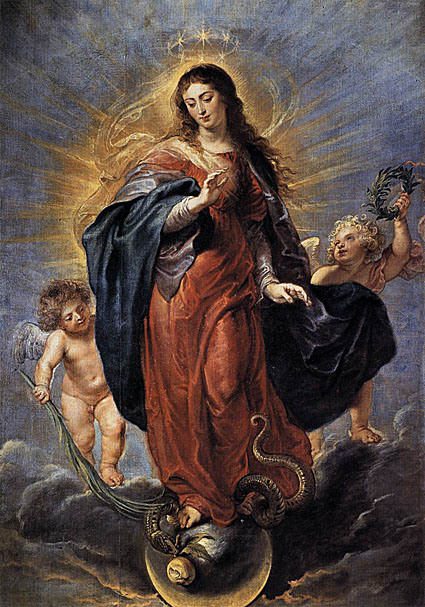
Peter Paul Rubens, 1628
Now, before any readers get there panties in a bunch, yes this is Church teaching. It is one of the earliest Traditions of the Church--that John did indeed refer to Mary with these words. Are there more than one meaning to these words? Of course, like many, many other prophecies and visions in the Bible, there is more than one meaning. However, the fact that this symbolizes or visualizes Mary is one of those meanings. In the next verses, it talks about the woman and her child being pursued by the dragon. I find it ironic that the child, son, man is almost universally said to Jesus by Christians, but that the woman is cannot be Mary. Huh??? That doesn't even make logical sense. Reading chapter 12 in light of Luke and Genesis gives us a pretty darned clear picture of Mary.

Also, when we read John chapter 19 we see how Jesus gave His mother to John. "Behold your mother. Woman behold your son." Jesus gave Mary to be the mother of the Apostle and by extension of the mother of his brothers and sisters. Note what it says in Revelation: 17 Then the dragon was enraged with the woman and went away to make war on the rest of her children, who obey God's commandments and have in themselves the witness of Jesus. Why was the dragon so enraged with the woman? Maybe, just maybe, because the Church teaching is correct--Mary was untouched by the sin that he had helped bring into the world (Original Sin). Maybe because he could not corrupt her (Mary's personal sinlessness). The Church Traditions about Mary, which date back to the first century of the Church, might just have some meaning after all, eh? This is why we call her our mother--Jesus gave His mother to be ours ("on the rest of her children, who obey God's commandments and have in themselves the witness of Jesus"). When looked at in the proper light, the light of Scripture and Tradition, it is pretty clear!


Immaculate Conception
Francisco Pacheco, 17th c.
I saw something on facebook today that I thought was pretty appropriate. It said (paraphrasing from memory): If you think the Catholic Church spends too much time on Mary, think about the fact that Jesus spent ten times more time with His mother than with His Apostles.
Think about it.

Some Reading and Resources for those interested:
*National Catholic Register Article, "8 Things You Need to Know About the Immaculate Conception" by Jimmy Akin.
*The Immaculate Conception (An Explanation of the Dogma) New Advent/Catholic Encyclopedia
*The Immaculate Conception explained Just for Catholics
*The Immaculate Conception, devotional Catholic Harbor of Faith and Morals

Ex Cathedra Debate

I have begun a debate with a non-denominational Christian by the name of David Rosenthal.  The question asked for this debate is "Are Ex Cathedra Statements from Popes Inconsistent with Scripture?"  Of course I have taken the negative and Mr. Rosenthal has taken the positive.  

As of this posting we're about half-way through the debate.  Stay tuned!

The webpage for the debate is here:


Swan on Luther's View of the Immaculate Conception

This posting is in response to a comment left by James Swan on his blog on 9:50 PM, December 17, 2011.  Since my response became too long for a combox reply, I am responding on my own blog with this posting.
 
I thought I'd add some faces to the names too and I know many have seen our faces before, but it doesn't hurt to put them out there again...
 
James Swan said...

James Swan
Hi Scott,

JS: Yes, it appears I was too hasty with your final comment. My apologies.

sw: Thank you, apology accepted.

JS: On the other hand,it does seem as if there's a jab with your words. When you say, "I suppose if you want to read Luther without considering the context of Luther - well, that speaks volumes." Are you attributing this to me? If so, you would be in error. 

Scott Windsor
sw: If you're reading Luther without considering the context of Luther's other writings, then it applies to you.  If you are including Luther's other teachings (like that of the "two conceptions") then it would not apply to you.  Either way, there's no error in what I said.


JS:  That was the sentence that provoked me to see your comment as insulting, and really covertly charging me with ignorance. 

sw: No, I am not charging you with anything!  I said, "I suppose if you want to..." - so, if you don't want to and/or are not doing so - then it does not apply to you.  Again, I specifically stated I was NOT accusing you of ignorance either overtly or covertly - we both know ignorance of Luther on this matter does not apply to you.

JS:  If though I've mis-read your words, my apologies. 

sw: Apology accepted, again.

JS:  This is one of the difficulties of printed word exchanges. 

sw:  Understanding someone's motives can be difficult in printed word exchanges, but my words were quite clear on this matter.  It is also better to seek clarification before jumping to conclusions in a printed only exchange.

JS:  You then went on to use the word "disingenuous". Are you inferring that you think my opinion on this topic fits that description? 

sw:  Only if the shoe fits!  If you are willing to accept that Luther's teachings on the Immaculate Conception go beyond the 1532 sermon - then that word and that sentence do not apply to you.  If, however, you're insisting that this 1532 sermon summarizes Luther's belief in the Immaculate Conception (or lack thereof) - then I would have to say that shoe does fit.  

JS:  If there's anyone clearly deceiving and disingenuous currently, it's Voris and his use of the Luther quote in question.Since you've taken up the gauntlet to defend him, you would best spend some of your apologetic time contacting Mr. Voris and help him post honest and well-researched materials.

sw: I have made an attempt to contact Mr. Voris.  Prior to this exchange I have had absolutely no contact with him.  I have seen his "RealCatholicTV" before, but haven't spent much time on it.

JS:  You've now said a few times that it is I and not you who has taken Luther out of context. This is nonsense. 

sw:  If you are not considering the 1527 sermon (and other teachings prior) when reading the 1532 sermon - then you are indeed reading Luther outside the context of Luther.

JS: You haven't even responded to the meat of my comments in this current discussion. 

sw: The "meat" of THIS discussion is based in Luther's expressed belief in the Immaculate Conception - a matter which you have conceded he most definitely held in his earlier life.  My contention is that he never rejected his earlier belief.  He may have stopped talking about it as openly, but - and I repeat - your argument is one from silence.  Silence lends itself to consent, not rejection. 

JS: While you're certainly entitled to your opinion, at this point, it is simply that: a groundless opinion.

sw: Groundless?  I've presented my case (repeatedly now) and you've had a good YEAR to dig up evidence of Martin Luther rejecting the Immaculate Conception, and you - whom I concede has read a lot more Luther than most Lutherans, including myself - a former Lutheran, have not been able to come up with that reference which would silence my argument and elicit my concession.

JS: Quite frankly, I find your opinion and apologetic on this entire issue absurd. I'm sorry if you find that insulting, but I can't think of kinder word, and I'm not saying it with any guile. It's absurd because you've taken a deleted section of a sermon which only in the earliest edition (of a very popular Reformation book, published over multiple years) and attempted to read it into later contexts of a man whose theology of Mary demonstratively changed over time. 

sw:  As long as we're being frank - I find your apologetic and opinion on this matter to be blinded by an anti-Catholic agenda.  All along I have not rejected that the later editions of the 1527 sermon have left out part of it - expressly THE part we're discussing.  Again, the ABSENCE of saying something is not a rejection of it!  Did Luther's views on Mary change throughout his life?  I won't argue against that!  All I AM saying is that while he one time explicitly supported and taught the Immaculate Conception, that even while he mellowed in his support and even didn't speak of it so concisely later on - he NEVER came out and REJECTED it either.

JS: Further, as I pointed out here, you've used a flawed methodology to arrive at the bulk of your conclusions.


sw: I've made ONE conclusion in regard to this topic.  I've been quite consistent in that conclusion for over a year now - and even with all your resources which you laud over others how much you spend on them - you have not been able to come up with even ONE SENTENCE from Luther stating he flatly rejected the concept of the Immaculate Conception.  What you HAVE been able to do is establish a valid argument that Luther believed Mary was made immaculate at the time of Christ's conception - and I gave you that LONG ago.  Basically that just makes Luther's position of Mary being immaculate (without sin) a matter of timing, but does not change the reality of his belief that she indeed was/is immaculate.  

sw:  You can lash out emotionally all you want and attempt to label my methodology as flawed or my opinion and apologetic as absurd - but I've really made ONE POINT which you cannot counter - hence the emotional responses and the attacks on the person (ad hominem) instead of just presenting the evidence to gain my concession - OR - just conceding that I too have a point here.

JS: I'll let you clarify if you wish to as to the above statements in question (whether or not you intended a jab), but there really isn't any need to. What your opinion of me one way or the other really doesn't matter.If you want to keep me interested, present facts, contexts, exegesis of text, and interpretations.

sw: All I said was that it would be disingenuous to look at Luther's 1532 sermon without considering what he said just a few years earlier.  Keeping Luther in the context of Luther.  There is no "jab" intended - I merely stated that you can look at Luther in the context of Luther, or you can isolate the 1532 sermon from his previous writings/teachings and make arguments from silence IF YOU CHOOSE.  I choose NOT to accept a modern view of Luther rejecting something he himself never rejects based upon arguments from silence.  If you DO want to consider Luther outside the context of Luther then don't consider it a jab, consider it a well placed right cross and consider changing your apologetic.

JS:  By the way, do you have a complete copy of the 1527 sermon you're using to interpret all of Luther's later comments on the Immaculate Conception, and have you read it? Do you have a complete copy of the 1532 sermon Voris cited and have you read it? Well, I have. 

sw: Whether or not I have the "complete copy of the 1527 sermon" or the 1532 sermon is really irrelevant to the argument at hand.  I not only have considered the 1527 sermon in context, I presented it - without your assistance. 

JS:  I suggest that if you intend to get in to this subject again you track down the sources (if you have not already), because the first thing I will jump on if you haven't is that your presenting an opinion on documents you've never read. 

sw: I have already provided a contextual response (click here) including the context from the 1527 sermon.  Earlier this year you and I discussed a sermon from 1538.  As for the 1532 sermon, here is the context of that statement:
Martin Luther
Mary said, Behold the handmaid of the Lord; be it unto me according thy word.
14. That day, that moment when Mary assented to the angel Gabriel’s announcement, Christ was conceived. In that hour when she said, “Be it unto me according to thy word,” she conceived and became the mother of God; and Christ, therewith, became true God and true man in one person. Even though he is a tiny fetus, at that moment he is both God and man in Mary’s womb, an infant, and Mary is the mother of God.
15. The Turks and the Jews make fun of this article of faith and feel that they have excellent reason to deride it. For that matter, we could banter about it as well as they. But as Christians, we must firmly hold onto this article of faith and never waver. From the beginning of time it has been prophesied that God’s Son would become man and that his mother would be a virgin. The first prophecy given Adam and Eve soon after the fall (Gen. 3:15) stated: “And I will put enmity between thee and the woman, and between thy seed and her seed; it shall bruise thy head, and thou shall bruise his heel.” God does not say the seed of the man, but rather the seed of the woman. Therefore, the mother of this serpent crusher must be a virgin. Later the patriarchs and the prophets also prophesied of this, until finally the beloved apostles proclaimed it to all the world. We have been baptized into this faith and are called Christians because we believe and confess it to be true. Let us, therefore, persevere unwaveringly in this faith. And if, as time goes on, sectarian spirits deny it, let us take a staunch stand in behalf of it.
16. This article is really the bottom line. Christ wanted his beginning to be like ours, but without sin, because he wanted to sanctify us wholly. We begin life in sin, we are conceived in sin, born in sin, no matter whether we be emperor, king, prince, rich, or poor; every human being is conceived in sin according to Psalm 51:5. Only Christ has the distinction and the honor to have been conceived by the Holy Ghost’s power. Since from our conception we are sinful, we are people whose flesh and blood and everything about us are soiled by sin, as indeed we see in ourselves; or when we look at those around us in the world, beset by evil desire, pride, multiple devils, and miserable unbelief. Thus we are conceived and born. For all of mankind is conceived and born in accord with creation’s decree, as recorded (Gen. 1:28): `Be fruitful, and multiply, and replenish the earth.” Christ could not be subject to such impure sinful conception and birth. He, indeed, was a genuinely true, natural human being, but not conceived or born in sin as all other descendants of Adam. That is why his mother had to be a virgin whom no man had touched, so that he would not be born under the curse, but rather conceived and born without sin, so that the devil had no right or power over him. Only the Holy Spirit was present to bring about the conception in her virgin body. Mother Mary, like us, was born in sin of sinful parents, but the Holy Spirit covered her, sanctified and purified her so that this child was born of flesh and blood, but not with sinful flesh and blood. The Holy Spirit permitted the Virgin Mary to remain a true, natural human being of flesh and blood, just as we. However, he warded off sin from her flesh and blood so that she became the mother of a pure child, not poisoned by sin as we are.
17. Thus what the angel spake came true: “He shall be great, and shall be called the Son of the Highest.” For in that moment when she conceived, she was a holy mother filled with the Holy Spirit and her fruit is a holy, pure fruit, at once true God and truly man, in one person. In time, then, this godly mother gave birth to God’s Son, a genuine man, but without any sin. Undoubtedly, his blood was red, his flesh, white; he suckled at his mother’s breasts, ate porridge, cried, and slumbered like any other child; but his flesh and blood were holy and pure. He is a holy person, the son of a pure virgin and God’s Son, true God and man in one person. [Sermons of Martin Luther Vol. 7 (Grand Rapids: Baker Books, 2000), pp. 291-293]. (Emphasis mine). Source: James Swan
sw: So, there we have the context of the 1532 sermon.   I repeat what I said a year ago when talking about the 1538 sermon, this statement from Luther does not preclude the possibility that he's talking about the Holy Ghost covering her and sanctifying her at her own conception - thus leaving MY position to be a valid one.  Whether or not you AGREE with what I've said is not the point!  
sw:  Now, would *I* use this 1532 sermon ALONE to prove Luther still held to the concept of Mary's Immaculate Conception?  No, but taken in the context of his 1527 and earlier statements, it CAN be seen as consistent with his belief in the "two conceptions" theory (which, again, is HIS theory and not mine!).

sw: James, I believe that all along you've been making more of my argument than I am!  I am not one out there arguing that Luther explicitly and concisely taught the 1854 definition of the Immaculate Conception - all I AM saying is that in his earlier life he not only accepted a belief not contrary with the 1854 definition but taught it as well.  Later in life, while he did not continue to be as explicit about he belief in Mary's being made immaculate by the Holy Ghost - he also never flatly rejected the belief or teaching.

In the spirit of the Holy Family (JMJ),
Scott<<<


White On The Vortex


White goes after "The Vortex"
40,000 Protestant denominations? Wow, we have proven the 33,000 number a bold-faced lie many times in the past, but hey, I guess it is just a matter of inflation! Hard to take promoters of Romanism who repeat these absurdities seriously...but it is even worse when they will stare into a video camera and claim that no one...NO ONE, ever accused Mary of sin until the Reformation!? I mean, the Immaculate Conception was not even defined as a dogma until the middle of the 19th century, and it is just too simple to provide citations proving such claims to be outright lies.
The 40,000 or 33,000 denominations statement is NOT a "lie" - and White has been shown this evidence in the past too - but rather a funky way of playing with the numbers.  The origin of that whole concept comes from a David A. Barrett 1995 report which counts each country that a given denomination exists in as another denomination.  By Barrett's numbering, while he has 33,000+ Protestant denominations - he also has the Catholic Church with 239 denominations in 234 countries (a statistical "1").  If we use the division of the countries into the overall count of denominations, the Protestantism is a statistical "140."  Protestantism still has a problem here because ANY NUMBER GREATER THAN "1" IS CONTRARY TO GOD'S WILL!  So, while 140 sounds a lot better to the Protestant than 33,000 (or 40,000) it is still greater than "1" and thus not within God's Will and Plan for His Church "That they may be One."  

White devotes the first part of his December 8th "Dividing Line Webcast" to the matter of Michael Voris, "The Vortex" (Voris' video was posted by me to this blog back on the Feast of the Immaculate Conception, the same day as White's entry) and to that portion, I will respond.


Webcast begins ripping on Voris' hair - as if that means anything, perhaps it does to one who has no hair?  Why even bring it up?  Does he have a toupee?  Who really cares?  After a bit of chit-chat on his server needs, he gets back to the Voris video - briefly.  After the first line from Voris about lies and falsehoods being trapped and exposed he digresses into a bit of whining about not being able to find Catholic apologists to debate him.  Then he talks about his upcoming course he'll be teaching and not talking about Voris' video!  Then finally, after nearly ten minutes, starts getting back to the audio from the video.  
9:58 (video time) - Voris states, "When Catholics celebrate the Feast of the Immaculate Conception, we have the esteemed privilege, yes privilege, of being caught up in the creative mind of God the Father in the desire He had from all eternity."  
White interrupts...
10:12 "Except that it's a dogma which did not become dogma until 1854 and was unknown, absolutely unknown in the early church.  In fact there are lots of quotations you can provide about that... I loved St. Bernard's against the concept, uh, how many people had argued against it and things like that.  I liked the comment of Ludwig Ott in Fundamentals of Catholic Dogma on page 221, "The dogma of the Immaculate Conception of Mary is not explicitly revealed in Scripture, neither the Greek nor Latin Fathers explictly teach the Immaculate Conception of Mary."  So, if this is in the mind of God, it took Him quite some time to finally get around to revealing it to men, which actually that would make it a new revelation because it's neither found in Scripture nor in Tradition, so it's revelation outside of the canon of the New Testament itself."

OK, now I must interject.  Dr. Ott stated the dogma/teaching is not explicitly found in Scripture or Tradition - and White jumps to it is not found, period.  That is not what Dr. Ott said, but purely an assertion of White's.  But is it not taught implicitly?  Let is look:

There are two passages in Scripture which point us to this truth. We look first at Genesis 3.15, in which we see the parallel between Mary and Eve of which the early Church Fathers already spoke: "I will put enmity between you and the woman, and between your seed and her seed: he shall bruise your head, and you shall bruise his heel." The Jews saw this passage as referring to the struggle between Christ and Satan, and so the Church see in "the woman" a prophetic foreshadowing of the Virgin Mary (Vatican II, Lumen gentium, # 55).  
Scotus wrote (cited from J. B. Carol, Mariology I, 368): "Either God was able to do this, and did not will to do it, or He willed to preserve her, and was unable to do so. If able to and yet unwilling to perform this for her, God was miserly towards her. And if He willed to do it but was unable to accomplish it, He was weak, for no one who is able to honor his mother would fail to do so."  http://www.ewtn.com/faith/teachings/marya2.htm 
Early Church Fathers:
"Every personal sin must be excluded from the Blessed Virgin Mary for the sake of the honor of God." - St. Augustine, 390 AD to Jehoel. 
"Mary, a virgin not only undefiled but a virgin whom grace has made inviolate, free from every stain." - St. Ambrose of Milan, 340-370 AD.
"You, and your Mother are alone in this. You are wholly beautiful in every respect. There is in you, Lord, no stain, nor any spot in your Mother." - St. Ephraem, 350 AD.
The concept of the Immaculate Conception of the Blessed Virgin is implied through these citations.  But wait!  There's more!

Theodotus, Bishop of Ancrya says:
“In place of Eve, an instrument of death, is chosen a Virgin, most pleasing to God and full of His grace, as an instrument of life. A Virgin included in woman’s sex, but without a share in woman’s fault. A Virgin innocent; immaculate; free from all guilt; spotless; undefiled; holy in spirit and body; a lily among thorns.” (Homily 6 in S. Deiparam, No. II, PG 77, 1427 A.)
He also spoke of Mary as being consecrated to the Creator before the Nativity (Homily 6, II; PO 19, 329). We can see a more developed knowledge of the Eve-Mary parallel from the quote above. Proclus of Constantinople makes a similar praise:
“He came forth from her without any flaw, who made her for Himself without any stain.” (Oratio I de Laudibus S. Mariae, PG, 65, 683 B.)   ....“Mary is the heavenly orb of a new creation, in whom the Sun of justice, ever shining, has vanished from her entire soul all the night of sin.” (Ibid, Oratio 6, PG 68, 758 A.)
Proclus also spoke of Mary as the ark of the Lord (Homily 5, 3; PG 65, 720 B). Hesychius of Jerusalem agrees with the consensus of the Fathers when he extolled the incorruptibility, immortality, immunity from concupiscence, impeccability, triumph over Satan, and the co-redemptive mission of the Mother of God (Oratio 39 in Sanctissimae Deiparae Annuntiationem, PG 85, 426).
From the sixth century, we have Anastasius I declare the privilege of the Immaculate Conception (Oratio 3 de Incarnatione, No. 6, PG 89, 1338). We also have Severus of Antioch who states:
“She…formed part of the human race, and was of the same essence as we, although she was pure from all taint and immaculate.” (Hom. Cathedralis 67)
Romanos the Melodist, whom the Byzantine Church proclaims as the cantor of the mysteries of Christ, and Mary says of Mary:
“…the tribes of Israel heard that Anna had conceived the immaculate one.” (On the Birth of Mary 4)
By the seventh century the doctrine of Mary’s freedom from original sin had become well elaborated that there was no controversy on the substance of the teaching (Carol, 1:354). Sophronius, the Patriarch of Jerusalem, describes Mary as:
“holy, immaculate in soul and body, entirely free from every contagion.” (Epistola Synodica ad Sergium, PG 87 (3), 3159; 3162)
He also speaks of the grace that no one has received besides her (Orat in Deiparae Annunt 25, PG 87, 3246-3247).
At the time of the eighth century, we have Andrew of Crete saying that the Redeemer was born from a pure and entirely Immaculate Virgin (Hom. in Dorm. Deipara). He also says:
“It was right, then, that the admirable Joachim and his spouse, Anna, inspired by divine thoughts, did obtain for her as the fruit of their prayer; her, I say, the queen of nature, the firstfruits of our race, whose birthday we celebrate, whose swaddling clothes we honor, and whom we venerate as the source of the restoration of our fallen race.” (Homily 3 on Mary’s Nativity, PG 97, 860 B-C)
Firstfruits of the human race in this text means that she is the first creature who received the gift of salvation (Gambero, 393). He then explains more fully:
“This is Mary the Theotokos, the common refuge of all Christians, the first to be liberated from the original fall of our first parents.” (Homily 4 on Mary’s Nativity, PG 97, 880 C)
We also have John Damascene who called Mary:
“the most holy daughter of Joachim and Anne, hidden from the fiery dart of Satan, dwelling in a bridal chamber of the spirit, preserved without stain as the Spouse and Mother of God.” (Homilia I in Nativitatem Beatae Virginis Mariae, No. 3, PG 96, 675) 
http://www.philvaz.com/apologetics/a95.htm
So much for the Early Church Fathers being silent on this matter!  
11:16 - Voris: "Most Protestants have no desire to hear talk of the Immaculate Conception of our Blessed Mother."
11:18 - White: "Well, except those of us who actually debate people, as I have, twice on this particular subject.  So, it's not a matter of our not wanting to talk about it.  I don't mind talking about it, its a great illustration of where the Catholic Church has defined something, de fide, which absolutely, positively has no foundation in either Scripture or Tradition."
Again, I must interject - we've just demonstrated that it CAN be seen in both Scripture AND Tradition - just not explicitly. 
11:43 - White: "Now the only thing which has less, (giggles) if you can have...  you can have no, but you can have less than none, (this makes no sense!) is the Bodily Assumption (of the Blessed Virgin).  Ah, but both of them, now de fide dogmas, of the Romanist (sic) system that have nothing to do with Scripture or Tradition which demonstrates that Roman Catholicism, um, is not bound by any external authority outside of itself.  These are both excellent examples of sola ecclesia, the Church as the sole and final rule of faith for itself.  It's not a three-legged stool, or anything like that.  It's not Church, Tradition and Magisterium, no it's just the Magisterium, period, end of discussion. 
Well, fist off, Catholics would not deny "sola ecclesia!"  The Ecclesia (Church) IS Scripture, Tradition and Magisterium!  Now of course White would like you to believe that we do not accept a "three-legged stool" approach - but in fact, we do.  He wants you to believe we preach it is all Magisterium - but we don't.  Secondly, I wish to point out that White is digressing again and not talking about the Immaculate Conception, but of Church authority and governance - and THIS discussion is not about the Assumption of the Blessed Virgin Mary!  That's a different subject - which I would be happy to deal with in the future.

White mentions that there are seven popes who taught against the Immaculate Conception and  numerous Early Church Fathers who talked about Mary's sin - "directly contrary to what Mr. Voris is going to say here in a moment..."

White then goes into another diatribe about the 33,000 denominations - I'll not bore you with all that again now, you can read my primary source material and see that White is just wrong here and disingenuously charging any Catholic who uses this number of bold-faced lying - when again, it's NOT a "lie" but just one way of looking at Barrett's 1995 numbers.  White carries on this 33,000 denominations discussion for a good six minutes... yawn.
  
For another 2 minutes White rambles on criticizing Roman Catholic apologists with empty assertions.  He hints about what Voris will discuss next (two founding Protestant leaders who believed in the doctrine of the Immaculate Conception long before it was defined as dogma) but then drifts back to the 33,000 denomination discussion again... yawn.

Finally, at the 22 minute mark in this webcast we get back to the Voris audio...
22:06 - Voris:  "Two founding fathers of their 16th century revolt against the Catholic Church each agree with..."
22:08 - White (in a gruff tone barges in):  "Revolt!  Revolting!"
22:14 - Voris:  "...with the doctrine of the Immaculate Conception."
22:16 - White: "No, they agree with the concept that was not yet a doctrine or a dogma.  See how different that is?
Well, it was a doctrine, it was a teaching, it was a celebrated feast day LONG before it was defined as dogma!  Perhaps White needs to brush up on the difference between doctrine and dogma?  Yes, the words CAN be used interchangeably at times - but fundamentally speaking, not all doctrines are dogmas - but all dogmas are doctrine.


White then makes the accusation of anachronism, he likes that word, and attempts to make a case that because it was not yet defined dogma in the time of Luther and Zwingli that they agreed with the "concept" but not as "doctrine."  The Feast of the Immaculate Conception was celebrated as such as early as the 5th century in the East and they refer to the Blessed Virgin as "achrantos" (spotless or immaculate).  In the West, the feast was celebrated as early as the 8th century.  By either account, it's nearly or over a millennium PRIOR to Luther and Zwingli!

Voris makes a statement that in the first 1500 years of Christendom NO ONE ever accused the Blessed Virgin of sin - that this was wholly something from the Protestant revolt of the 16th century.  White then names a few Church Fathers whom allegedly state Mary sinned..  That being said, I will not state that NO Church Father or ANYONE prior to the 16th century EVER stated Mary sinned - nor would it shake my faith if White, or anyone else, could present a quote here or there.  Voris may have been caught in a bit of hyperbole there - but the fact remains, the Feast of the Immaculate Conception was celebrated in the East over 1000 years prior to Protestantism's dawning - and some 800 years prior in the Western tradition. 


White concludes his on-topic discussion (he does go off on some other distractions after this) with a question for Voris:
33:43 - White: "One simple question Mr. Voris, and if you were ever to step out and debate these things in public, it's a question I'd ask you then, and I don't mind telling what the question is now because to be honest with you there is no meaningful answer to this question. (1) But Mr. Voris, do you really think that is what Mary meant when she said that?  (2) Do you really think that Mary, in her Magnificat, that she actually was saying that when she called God her Savior she recognized that she had been kept from the stain of Original Sin by the preemptive application and the merits of the Sacrifice of Jesus Christ when she did not even understand at that point in time what Jesus was going to have to do on the Cross? (3) Are you SERIOUSLY telling me that?
Now, I won't continue in White's preemptive answering, but I will answer him myself, and there's more than one question here, so let's answer them all (I've added numbers above to keep track)
(1) The words of the Magnificat are simply:


My soul doth magnify the Lord.
And my spirit hath rejoiced in God my Saviour.
Because he hath regarded the humility of his handmaid;
for behold from henceforth all generations shall call me blessed.
Because he that is mighty,
hath done great things to me;
She is saying that her soul magnifies the Lord... her spirit rejoices in God her Savior - why?  Because He has regarded the humility of His handmaid (past tense) and from that time forward, all generations will call her blessed (future tense) because He has done (past tense again) great things to me.  God had already done great things to her.


(2) Look at it this way, it's not such a great thing to accomplish to get pregnant, so she wasn't talking about merely being pregnant with her God and Savior - but that God had already done great things to His humble handmaid.  Is this explicitly stating she was immaculately conceived?  No, but it's recognizing something "great" had already been done TO her.  


(3) To be preserved from the stain of Original Sin would be a "great thing."  To do this so that she could be the Ark of the New Covenant is a "great thing."  If you "SERIOUSLY" want to disbelieve - then sobeit.

I will close with this thought...  Frequently throughout this Dividing Line program, White is goading Voris to debate with him.  White has always been huge on debating, and I will acknowledge, he's pretty good at it!  I too used to be a bit more interested in formal debating, and while I've not abandoned it (I'll still engage in one, even with White if he chooses) in a debate, just because someone can present a better argument does not necessarily equate to the Truth "winning."  I've seen several debates where White would appear to "win" the debate, or at least part of the debate, yet it was not Truth which "won" - rather a tactful "gotcha" argument was used and his opponent was not prepared to answer him.  This is also why I prefer a WRITTEN debate as opposed to a face-to-face one.  When one has the time to research and respond in a scholarly fashion - White is put on an equal footing - and, at least in confrontations I've had with him - he cannot (or will not) answer to his (many) mistakes (well, there is ONE time that I can recall, in over 20 years of debating him where he admitted to a minor mistake).  Debating has its place, as it can help refine our own defenses and arguments - but such is RARELY the "end-all" in apologetics.

In JMJ,
Scott<<<


Feast of the Assumption

 The Feast of the Assumption of the Blessed Virgin Mary - another example of "not-so-ordinary" days! These are COUNTING days - and...