Showing posts with label Saints. Show all posts

Saints of the Day - January 8

 Well, there are actually many Saints for January 8th, I will select a couple:

 St. Patiens, Bishop of Metz

Saint Patiens is said to have been a disciple of Saint John the Evangelist, and to have been sent by him into Gaul. He settled at Metz, where he became the fourth Bishop. (Baring-Gould, 2014). Others put his feast day on November 12.

St. Apollinaris the Apologist

Of course, an apologist has to be on the list of the Saints I would select for today! 

He was a second-century bishop of Heirapolis, Phrygia. Held in high regard by other early saints including Saint Jerome and the historian Theodoret. Noted for writing a defense of the faith to Emperor Marcus Aurelius that reminded the Emperor of a miraculous victory that resulted from the prayers of Christian soldiers, and of his promise of protection for Christians. Worked and wrote against all the major heresies of his time, refuting them by logically destroying the heresy‘s philosophical roots. A prolific writer, though most of his work has been lost over the centuries. (Saint Apollinaris the Apologist, 2021).


References

 Baring-Gould, S. (2014). Saint Patiens, Bishop. Lives of the Saints, 1897 <https://catholicsaints.info/baring-goulds-lives-of-the-saints-saint-patiens-bishop/>

Saint Apollinaris the Apologist (2021). CatholicSaints.Info. <https://catholicsaints.info/saint-apollinaris-the-apologist/>

Patron Saint of Ireland - Patrick

BUT!  Then you hear or read of those who proclaim that St. Patrick was never officially declared a Saint by the Catholic Church - and most of us then say, um, WHAT?! While it is true that St. Patrick was not declared a Saint, in the same manner, most other Saints have been so declared - one must look at the REASON his canonization was different. The fact is, in the first millennium the formal canonization process had not been fully developed. However, to proclaim he was never officially canonized is simply NOT TRUE! The fact of the matter is, in ancient times, starting about 787 A.D., a new church had to have a relic from a Saint before it could be consecrated.

In 1177, a knight named John de Courcy built a new monastery and he, with Bishop Malachy, applied to Pope Urban III for permission to have the remains of Sts. Patrick, Brigid, and Columcille moved to the new monastery. An investigation was conducted and a Solemn Translation (elevato corporis) was approved. Pope Urban sent Cardinal Vivian with his official commission for the verification of the sanctity of the persons (Patrick, Brigid, and Columcille), followed by an all-night vigil prior to moving the remains. For the day, this WAS an official declaration of sainthood by and through the Catholic Church (McCormick, 2011). 

The process of declaring one a saint has changed many, many times throughout the ages, most recently in 1983 and 1997 (McCormick, 2011). So, while St. Patrick's official canonization was not according to the modern means - he was most definitely recognized as a Saint of the Catholic Church and BY the Catholic Church in 1177 A.D.


References

McCormick, M. (2011). St. Patrick IS a Saint! Ancient Order of Hibernians.                https://aoh.com/2011/03/01/st-patrick-is-a-saint/ 

Purgatory


Reflecting on Fr Kyle’s homily last Sunday, I thought I’d say a few words on Purgatory.  Recall that last Sunday was November 2nd , the feast of All Souls Day, the Commemoration for all the faithful departed.  The day before we celebrated the feast of All Saints Day, celebrating all those faithful servants that have “attained the victory of Heaven.”

What’s the difference between ‘All Souls Day’ and ‘All Saints Day’ you say?  The fundamental difference is that the Saints we are celebrating on Nov 1st are in heaven and therefore when we pray to them we are celebrating their accomplishment and asking them to pray for us and with us to Jesus.  On Nov 2nd though, we are celebrating those souls that are destined for heaven but may be in the final process of being sanctified, ie Purgatory.  We pray to God for their early release and/or to ease their suffering.

Paul said: “11 For no one can lay any foundation other than the one that has been laid; that foundation is Jesus Christ. 12 Now if anyone builds on the foundation with gold, silver, precious stones, wood, hay, straw— 13 the work of each builder will become visible, for the Day will disclose it, because it will be revealed with fire, and the fire will test what sort of work each has done. 14 If what has been built on the foundation survives, the builder will receive a reward. 15 If the work is burned up, the builder will suffer loss; the builder will be saved, but only as through fire.(1 Cor 3:11-15)

You’ll notice that Paul is speaking of the Day of one’s particular judgment where his works will be tested through fire on the day of his death, the Day.   Paul is describing the method of purifying gold and precious metals and tying it to burning impure works and leaving behind the true works of God.   There is a lot of other metals and impurities in raw gold.  To remove these impurities we heat the nugget and its impurities so that the impurities burn away leaving behind pure gold.  Paul describes the removal impurities from our works.  This process is a painful one since the one who goes through this “will suffer loss.”  This state of being cannot be Heaven since this process is painful and there is no pain and suffering in Heaven.  This state of being cannot be Hell either since we know that he “is saved”.  This process is neither Heaven nor Hell, it is what we call Purgatory.  It is how we become clean from all our sins and attachment to sins.  This is how we are ‘purged’ from our impurities and become worthy of heaven (Rev 21:27).
God Bless
Nathan

Abp. Fulton Sheen Canonization Cause Suspended

The cause for canonization of Venerable Archbishop Sheen has been suspended...

Catholic Diocese of Peoria
Spalding Pastoral Center
419 N.E. Madison Avenue
Peoria, IL 61603
309.671.1550
NEWS RELEASE
The Diocese of Peoria, Illinois
Wednesday, September 3, 2014
Sheen Cause Suspended, Call for Prayer

It is with immense sadness that the Most Reverend Daniel R. Jenky, CSC, Bishop of Peoria and
President of the Archbishop Fulton J. Sheen Foundation, announced today that the Cause for
Sheen’s beatification and canonization has for the foreseeable future been suspended. The
process to verify a possible miracle attributed to Sheen had been going extremely well, and only
awaited a vote of the Cardinals and the approval of the Holy Father. There was every indication
that a possible date for beatification in Peoria would have been scheduled for as early as the
coming year. The Holy See expected that the remains of Venerable Sheen would be moved to
Peoria where official inspection would be made and first class relics be taken. Subsequently, the
Archdiocese of New York denied Bishop Jenky’s request to move the body to Peoria. After
further discussion with Rome, it was decided that the Sheen Cause would now have to be
relegated to the Congregation’s historic archive.

Countless supporters especially from the local church in Central Illinois have given their time,
treasure and talent for this good work with the clear understanding that the body of Venerable
Sheen would return to the Diocese. Bishop Jenky was personally assured on several occasions
by the Archdiocese of New York that the transfer of the body would take place at the appropriate
time. New York’s change of mind took place as the work on behalf of the Cause had reached a
significant stage.

Bishop Jenky is what is technically called the “actor” of the Sheen Cause. The Diocese of Peoria
and the Sheen Foundation have prayed and labored for this good work for the last twelve years.
The Bishop is heartbroken not only for his flock in Peoria but also for the many supporters of the
Sheen Cause from throughout the world who have so generously supported Peoria’s efforts. It
should be noted, however, that saints are always made by God not by man. Efforts for many
causes have sometimes taken decades or even centuries. Bishop Jenky urges that those who
support the Sheen Cause continue their prayers that God’s will be made manifest.


NEWS RELEASE
The Diocese of Peoria, Illinois
Friday, September 5, 2014
Diocese of Peoria Presents Additional Clarifications Regarding the Suspension
of the Archbishop Fulton Sheen Cause of Sainthood
For Immediate Release

PEORIA, IL - After an outpouring of great support for the actions taken by Most Reverend
Daniel R. Jenky, C.S.C., Bishop of the Diocese of Peoria regarding the suspension of the
Archbishop Fulton Sheen Cause of Sainthood, the Diocese is providing additional clarifications.
According to the Chancellor of the Diocese of Peoria, Patricia Gibson, who has worked with the
Cause from the beginning, “Bishop Jenky only agreed to pursue the cause for canonization of
Fulton Sheen after he was assured by the Archdiocese of New York that they had no interest in
pursuing the cause but would support Peoria’s efforts. Specifically, Bishop Jenky was told by
Cardinal Egan in September 2002 that New York was not interested in pursuing the cause. He
also indicated that at the appropriate time he would facilitate the transfer of the body to Peoria.
In December 2004, Cardinal Egan again confirmed at a meeting in New York with Bishop Jenky
that he continued to support the efforts of the Cause and reassured him that he would work to
transfer the body at the appropriate time to be enshrined in the Peoria Cathedral.”

Based on this ongoing assurance, Bishop Jenky wrote to the Congregation for the Causes of
Saints in early 2005 asking for the body to be transferred to Peoria. They did not in any way
forbid the transfer of the body but simply indicated that it was not the appropriate time. The
Congregation indicated that “the transfer was not opportune at this time because the Diocesan
inquiry had just been started in the Diocese of Peoria.” With this inquiry complete and a miracle
being attributed to Sheen, now is an appropriate time.

On June 27, 2014, the Diocese of Peoria received the most recent communication from the
Archdiocese of New York. This letter from its lawyer definitively stated that it would never
allow the examination of the body, the securing of relics or the transfer of the body. Upon
receiving this shocking statement and consulting with advisors to the Sheen Cause, Bishop Jenky
believed that he had no choice but to stop his efforts and suspend the Cause.

Gibson added, “It is essential to realize that Bishop Jenky now feels a great responsibility to be
faithful to the thousands of supporters throughout Central Illinois, the nation and the world, in
regard to the status of the cause. From the beginning, Bishop Jenky sought assurances that New
York did not want to undertake the Cause and would support Peoria’s efforts. This assurance
was given before the process ever began. Bishop Jenky also confirmed that at the appropriate
time Fulton Sheen’s body would be transferred to his boyhood home and be placed in a shrine in
St. Mary’s Cathedral where he was ordained. Over the last twelve years, countless people have
offered their time and financial support for these efforts in order not only to spread the word
about Fulton Sheen’s virtues and holiness but also to prepare a shrine in Peoria upon his
beatification. After New York clearly turned down the Cause, Peoria was happy to put forth the
lengthy work and effort because of how much he is loved by the priests and lay faithful in this
Diocese.”

Clearly Archbishop Sheen’s wishes for his final resting place could not have anticipated that he
would go through a canonization process led by his native Diocese of Peoria, after it was turned
down by the Archdiocese of New York. The Diocese of Peoria has heard from several relatives
this week regarding their desire that Bishop Jenky continue to work towards having the body
transferred as was presumed from the beginning.

The Chancellor, Patricia Gibson, further states, “The actions taken by Bishop Jenky this week
reflect his strong desire to be true to the countless supporters of the Archbishop Fulton Sheen
Cause who for over twelve years have labored and supported bringing the message of Fulton
Sheen and his sanctity to the world. Bishop Jenky continues to hope that the promises made
twelve years ago will be honored.”

Let us pray that these issues would be resolved and the matter be continued to move forward.


Communion of Saints


In today’s second reading we find that there is a great cloud of witnesses surrounding us.  Reading Hebrews 11, the previous chapter of today’s reading, tells us that these witnesses are the Old Testament saints.


These ‘dead’ saints who are alive in Christ are aware of what’s happening to us.  Here are few verses to show this awareness of those in heaven of what is happening here on Earth.


Heb 12:1          “Therefore, since we are surrounded by such a great cloud of witnesses, let us throw off everything that hinders and the sin that so easily entangles, and let us run with perseverance the race marked out for us.”


Mt 17:3            Just then there appeared before them Moses and Elijah, talking with Jesus.


(If Jesus didn’t want any contact between saints on earth and saints in heaven, why did our Lord make a special point of appearing to Peter, James, and John on the Mount of Transfiguration in the company of Moses and Elijah, two ‘dead’ saints? (Patrick Madrid))


Rev 6:9-10       When he opened the fifth seal, I saw under the altar the souls of those who had been slain because of the word of God and the testimony they had maintained. They called out in a loud voice, How long, Sovereign Lord, holy and true, until you judge the inhabitants of the earth and avenge our blood?


Luke 15:10       …There is joy in the presence of the angels of God over one sinner that repents.


We have just learned that the ‘dead saints’ are indeed aware of earthly doings, but can they do anything about it?  Are there intercessory prayers effective?  Of course there are.  Prayers of the righteous availeth much (Jas 5:16).  Who are more righteous than those who have been made perfect (Mat 5:48) and in heaven?


I feel I must make clear that Jesus alone is our mediator, John Henry Cardinal Newman pointed out:

The Catholic Church allows no…Saint, not even the Blessed Virgin herself, to come between the soul and its Creator…The devotions then to angels and saints as little interfered with the incommunicable glory of the Eternal, as the love which we bear our friends and relations, our tender human sympathies, are inconsistent with that supreme homage of the heart to the Unseen.  (Newman, Apologia Pro Vita Sua, p.284-285)


We can therefore see that asking saints to pray for us (whether they are ‘living’ or ‘dead’) is acceptable, approved by God, and avails much. 


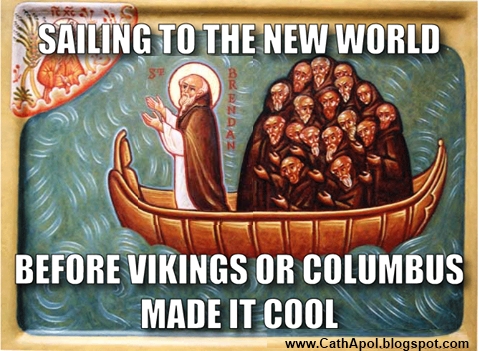
Happy St. Brendan's Day

One of my favorite saints and my eldest son's namesake.  [Image posted on facebook]
Happy St. Brendan's Day!


St. Catherine of Siena

Saint and Doctor of the Catholic Church, St. Catherine of Siena is one of the great Saints of the Catholic Church.  April 29th is her feast day, which is the anniversary of her death in 1380 at the young age of 33 years old.  In 1430 her body was found, incorrupt.
St. Catherine was given the penance of the stigmata, however this was not known while she was alive - it was a penance she kept to herself and it was discovered after her death.  She is sometimes depicted, as above, with a crown of thorns for in a vision Jesus had offered her the choice between two crowns, one of gold the other of thorns - she chose the crown of thorns.  

She was born with her twin sister, Giovanna, but Giovanna died shortly after birth.  St. Catherine was the 23rd child in their family (but at least half of the other children died).  The 25th child, a daughter, was also named Giovanna.

St. Catherine wrote over 300 letters, most of which exist to this day.  Perhaps the most famous work of hers is The Dialogue of Divine Providence, which is the dialog of a soul which "rises up" to God and God Himself.

She is one of two Saints declared to be Patron of Italy - the other is St. Francis of Assisi.

St. Catherine of Siena is also the patron of Theta Phi Alpha which adopted her motto as their own:  “Nothing great is ever achieved without much enduring.”
 

For more reading:

http://www.catholic.org/saints/saint.php?saint_id=9

http://en.wikipedia.org/wiki/Catherine_of_Siena


Solemnity of Mary, Mother of God

Today is a Holy Day of Obligation.  All practicing Catholics must attend Mass today.  The one person we honor above all others, except Jesus Christ Our Lord, is the Blessed Virgin Mary.  Today is the day that we honor her motherhood of the Divine person. 

"What the Catholic faith believes about Mary is based on what it believes about Christ, and what it teaches about Mary illumines in turn its faith in Christ."  (CCC 487)

To most Catholics, this statement seems pretty clear.  Some may have heard this logic statement: If Jesus is God, and Mary is the mother of Jesus, then Mary is the Mother of God.  Everything we believe about St. Mary comes directly from what we believe about Our Lord Jesus.  Since we believe Jesus Christ to be God Incarnate, it is right to call His mother, Mother of God.  Either He is God or He isn't.  Today we celebrate the fact that Jesus was "Incarnate of the Virgin Mary and became man."  (Nicene Creed)

Today's readings are:  Numbers 6:22-27; Psalm 67:2-3,5,6,8; and Galatians 4:4-7.

Today's Gospel is from Luke 2: 16-21:

The shepherds went in haste to Bethlehem and found Mary and Joseph,
and the infant lying in the manger.
When they saw this,
they made known the message
that had been told them about this Child.
All who heard it were amazed
by what had been told them by the shepherds.
And Mary kept all these things,
reflecting on them in her heart
.
Then the shepherds returned,
glorifying and praising God
for all they had heard and seen,
just as it had been told to them.

When eight days were completed for His circumcision,
He was named Jesus, the name given Him by the angel
before He was conceived in the womb.
 
One thing that many of the first "reformers" did agree on with the Catholic Church was honoring Mary.  These beliefs were later dropped by most of their followers.
 
"She is rightly called not only the mother of the man, but also the Mother of God ... It is certain that Mary is the Mother of the real and true God."  --Martin Luther
 
"Elizabeth called Mary Mother of the Lord, because the unity of the person in the two natures of Christ was such that she could have said that the mortal man engendered in the womb of Mary was at the same time the eternal God."  --John Calvin
 
"I esteem immensely the Mother of God, the ever chaste, immaculate Virgin Mary." --Ulrich Zwingli

There is quite a lot of evidence that the early Church called St. Mary the Mother of God and honored her as such.  Below is just a small sampling.

"After this, we receive the doctrine of the resurrection from the dead, of which Jesus Christ our Lord became the first-fruits; Who bore a Body, in truth, not in semblance, derived from Mary the mother of God in the fullness of time sojourning among the race, for the remission of sins: who was crucified and died, yet for all this suffered no diminution of His Godhead."
--Alexander of Alexandria, Epistle to Alexander, 12 (A.D. 324).

"Many, my beloved, are the true testimonies concerning Christ. The Father bears witness from heaven of His Son: the Holy Ghost bears witness, descending bodily in likeness of a dove: the Archangel Gabriel bears witness, bringing good tidings to Mary: the Virgin Mother of God bears witness: the blessed place of the manger bears witness."
--Cyril of Jerusalem, Catechetical Lectures, X:19 (c. A.D. 350).
 
"And the Angel on his appearance, himself confesses that he has been sent by his Lord; as Gabriel confessed in the case of Zacharias, and also in the case of Mary, bearer of God."
--Athanasius, Orations III, 14 (A.D. 362).

"To the question: 'Is Mary the bearer of Man, or the bearer of God?' we must answer: 'Of Both.'"
--Theodore of Mopsuestia, The Incarnation, 15 (ante A.D. 428).

Today we honor Mary, the Mother of God.  I close with one last quote:

"Whoever honors the Lord also honors the holy [vessel]; who instead dishonors the holy vessel also dishonors his Master. Mary herself is that holy Virgin, that is, the holy vessel"
--Epiphanius, Panarion, 78:21 (A.D. 377).

Our Lady of Guadalupe, Feast Day December 12

Photograph of image by Bill Bell
Of the many, many apparitions of the Blessed Mother, Our Lady of Guadalupe is one of the most famous.  The message of Our Lady of Guadalupe in 1531 was a pro-life one.  After identifying herself to Juan Diego as the Blessed Mother of the one true God, creator of the universe (of course, she was referring to Jesus Christ, God the Son), she asked that a church be built on the site where she appeared.  The hill where she met St. Juan had once been the site of human sacrifices to the pagan gods.  The Blessed Mother asked that the chapel be built so that those who came there would believe in the one, true God, the God of Life.

Mary's Message to Juan:

"Dear little son, I love you. I want you to know who I am.
I am the Virgin Mary, Mother of the one true God, of Him who gives life.
He is Lord and Creator of heaven and of earth.
I desire that there be built a temple at this place where I want to manifest Him,
make him known, give Him to all people
through my love, my compassion, my help, and my protection.
I truly am your merciful Mother, your Mother
and the Mother of all who dwell in this land, and of all mankind,
of all those who love me, of those who cry to me,
and of those who seek and place their trust in me.
Here I shall listen to their weeping and their sorrows.
I shall take them all to my heart, and I shall cure their many sufferings,
afflictions, and sorrows.
So run now to Tenochtitlan and tell the Lord Bishop all that you have seen and heard."

18th c. painting of God, the Father
"painting" the image on the tilma
The bishop asked for a sign from the Lady because he did not believe St. Juan at first.  The Lady told St. Juan, in his native tongue, to gather the roses on the hill.  He was surprised to see the roses but obeyed the lady and gathered them in his tilma, a sort of cloak woven from certain grasses.  When he went back to the bishop and open his tilma, the roses tumbled out onto the floor revealing the miraculous image of Our Lady on the tilma.  Of course, the bishop believed him then.  A church was built on the spot soon afterward.  Mary appeared as a young woman of Aztec decent, speaking their language. The conversion of millions of native Mexicans were credited to Our Lady of Guadalupe.

Some interesting facts about the appearance:
1) The original tilma worn by St. Juan Diego is still intact and on display in the basilica.  The only specimen of its kind that is over 500 years old.

2) Scientific studies show that the image is painted by "brushes not of this world." (Pope Blessed Pius XII)

Close up of the face of
Our Lady of Guadalupe
3) Scientific studies also show that microscopic images of the persons present in 1531 appear inside the eyes of the image.  The bishop and several others can be seen there. 

4) The Castillian roses that grew on Tepeyac Hill that day were not native to Mexico and did not normally grow in December.  Roses are a sign associated with the Blessed Virgin in several of her apparitions (for instance, the roses on her feet at Lourdes, France, in 1858).

5) A drawing of the image of Our Lady on a document dated to 1540 was discovered in 1995, proving the image to date back to that date.  The oldest written document, a sermon mentioning the image, dates to 1556.

6) Our Lady of Guadalupe holds the titles:  Patroness of the Americas, Empress of Latin America, Queen of Mexico, and Patroness of the Unborn

Readings for the Daily Mass on the Feast of Our Lady of Guadalupe:

Painting of Our Lady's appearance to
St. Juan Diego
First Reading:
Sing and rejoice, O daughter Zion!
See, I am coming to dwell among you, says the LORD.
Many nations shall join themselves to the LORD on that day,
and they shall be his people,
and he will dwell among you,
and you shall know that the LORD of hosts has sent me to you.
The LORD will possess Judah as his portion in the holy land,
and he will again choose Jerusalem.
Silence, all mankind, in the presence of the LORD!
For he stirs forth from his holy dwelling.
Zech 2:14-17

Responsorial Psalm Jdt 13:18bcde, 19
R. (15:9d) You are the highest honor of our race.
Blessed are you, daughter, by the Most High God,
above all the women on earth;
and blessed be the LORD God,
the creator of heaven and earth.
R. You are the highest honor of our race.
Your deed of hope will never be forgotten
by those who tell of the might of God.
R. You are the highest honor of our race.
 
Gospel Lk 1:26-38
The angel Gabriel was sent from God
to a town of Galilee called Nazareth,
to a virgin betrothed to a man named Joseph,
of the house of David,
and the virgin's name was Mary.
And coming to her, he said,
"Hail, full of grace! The Lord is with you."
But she was greatly troubled at what was said
and pondered what sort of greeting this might be.
Then the angel said to her,
"Do not be afraid, Mary,
for you have found favor with God.
Behold, you will conceive in your womb and bear a son,
and you shall name him Jesus.
He will be great and will be called Son of the Most High,
and the Lord God will give him the throne of David his father,
and he will rule over the house of Jacob forever,
and of his Kingdom there will be no end."
But Mary said to the angel,
"How can this be,
since I have no relations with a man?"
And the angel said to her in reply,
"The Holy Spirit will come upon you,
and the power of the Most High will overshadow you.
Therefore the child to be born
will be called holy, the Son of God.
And behold, Elizabeth, your relative,
has also conceived a son in her old age,
and this is the sixth month for her who was called barren;
for nothing will be impossible for God."
Mary said, "Behold, I am the handmaid of the Lord.
May it be done to me according to your word."
Then the angel departed from her.
 
"From Mary we learn to surrender to God's will in all things. From Mary we learn to trust when all hope is gone. From Mary we learn to trust her Son and Christ the Son of God."

Further Reading:
Catholic Online Article on Our Lady of Guadalupe with several sources linked


Sacrament of Confession (Reconciliation or Penance)


In the Gospel of John, we see the power to forgive sins conferred by Jesus Christ upon the Apostles. The power to forgive sins conferred upon priests validly ordained by a bishop would play a prominent role in the life and miracles of Padre Pio. From 1918 to 1923, Padre Pio heard confessions fifteen to nineteen hours every day. In the 1940s and 1950s, he generally heard confessions somewhat less than that, but still five to eight hours every day.

So many people wanted Padre Pio to hear their confessions that they generally had to wait two or three weeks before their turn came. A numbering system began to be implemented in January, 1950. There was also a rule instituted that you couldn’t go to confession to Padre Pio more than once every eight days.

One man from Padua, who had gone to confession to Padre Pio, tried to go to confession again before the eight-day waiting period had elapsed. In order to circumvent the waiting-period, he lied about the amount of days that had passed since his last confession to Padre Pio. When he entered the confessional, Padre Pio sent him out and forcefully accused him of his lie. After being kicked out, the man said with tears, “I’ve told many lies during my lifetime, and I thought I could deceive Padre Pio too.” But Padre Pio had a supernatural knowledge of his action.

Padre Pio demanded that each confession be a true conversion. He didn’t tolerate a lack of honesty in the explanation of sins. He was very hard on those who made excuses, spoke insincerely, or lacked a firm resolution to change. He demanded frankness and total honesty from the penitent. He also required a true and sincere sorrow of heart, and an absolute firmness in a person’s resolutions for the future.

If the penitent wasn’t honest, or just read through the list of his or her sins without the firm resolution to change, Padre Pio would often growl “get out.”

One man who was thrown out of the confessional by Padre Pio stated: “What kind of blackguardly monk is that? He did not give me time to say a word, but straightway called me an old pig and told me to get out!” Another person said to this man that Padre Pio probably had good reasons for calling him an old pig and treating him in this way. “I can’t think why,” said the man who had been thrown out of the confessional; and then, after a pause, the man said: “unless it is because I happen to be living with a woman who is not my wife.”

There are too many such stories to recount them all but I’ll share with you one more extraordinary anecdote and refer you to go do your own internet search or simply go to http://www.mostholyfamilymonastery.com/padre_pio.php


Frederick Abresch was one of those penitents who had been converted after going to Padre Pio for confession. Here are some of the things he described about the story of his incredible conversion:

“In November of 1928, when I went to see Padre Pio for the first time, it had been a few years since I had passed from Protestantism to Catholicism, which I did out of social convenience. I did not have the faith; at least now I understand that I was merely under the illusion of having it. Having been raised in a highly anti-Catholic family and imbued with prejudices against dogmas to such a degree that a hasty instruction was unable to wipe out, I was always avid for secret and mysterious things.

“I found a friend who introduced me into the mysteries of spiritism. Quite quickly, however, I got tired of these inconclusive messages from beyond the grave; I went fervently into the field of the occult, magic of all sorts, etc. Then I met a man who declared, with a mysterious air, that he was in possession of the only truth: ‘theosophy’. I quickly became his disciple, and on our nightstands we began accumulating books with the most enticing and attractive titles. With self-assurance and self-importance, I used words like Reincarnation, Logos, Brahma, Maja, anxiously awaiting some great and new reality that was supposed to happen.

"I do not know why, although I believe it was above all to please my wife, but from time to time I still continued to approach the holy Sacraments. This was my state of soul when, for the first time, I heard of that Capuchin Father who had been described to me as a living crucifix, working continual miracles.

“Growing curious… I decided to go and see with my own eyes… I knelt down at the confessional [and told Padre Pio that]… I considered confession to be a good social and educational institution, but that I did not believe in the divinity of the Sacrament at all… The Padre, however, said with expressions of great sorrow, ‘Heresy! Then all your Communions were sacrilegious… you must make a general confession. Examine your conscience and remember when you last made a good confession. Jesus has been more merciful with you than with Judas.’

“Then, looking over my head with a stern eye, he said in a strong voice, ‘Praised be Jesus and Mary!’ and went over to the church to hear the women’s confessions, while I stayed in the sacristy, deeply moved and impressed. My head was spinning and I could not concentrate. I still heard in my ears:‘Remember when you last made a good confession!’ With difficulty I managed to reach the following decision: I would tell Padre Pio that I had been a Protestant, and that although after the abjuration I was rebaptized (conditionally), and all the sins of my past life were wiped out by virtue of holy Baptism, nevertheless, for my tranquility I wanted to begin the confession from my childhood.

“When the Padre returned to the confessional, he repeated the question to me: ‘So when was the last time you made a good confession?’ I answered, ‘Father, as I was…’ but at that point the Padre interrupted me, saying, ‘…you last made a good confession when you were coming back from your honeymoon, let’s leave everything else aside and begin from there!’

“I remained speechless, shaken with a stupor, and I understood that I had touched the supernatural. The Padre, however, did not leave me time to reflect. Concealing his knowledge of my entire past, and in the form of questions, he listed all my faults with precision and clarity… After the Padre had brought all my mortal sins to light, with impressive words he made me understand the gravity of these faults, adding in an unforgettable tone of voice, ‘You have sung a hymn to Satan, while Jesus in His ardent love has broken His neck for you.’ Then he gave me my penance and absolved me… I believe not only in the dogmas of the Catholic Church, but also in the least of its ceremonies… to take away this faith, one would have to take away my life as well.’’

Padre Pio died in 1968 at the age of 81 and carrying the stigmata for 50 years. His legacy included 726 prayer groups with 68,000 members. There are also twenty-two Padre Pio centers for handicapped children and one center for the blind. As an example of the profound influence of his life, in 1997 six and a half million people visited Padre Pio’s tomb.

Padre Pio said what he would do after he died. “I have made a pact with the Lord: when my soul has been purified in the flames of purgatory and deemed worthy to be admitted to the presence of God, I will take my place at the gate to paradise, but I shall not enter until I have seen the last of my spiritual children enter.”

Let us take advantage of such a gift of God by going to confession, to avail ourselves of the Sacrament of Reconciliation as often as possible.


Missed past week’s leaflets? Questions? Comments? Come visit our Blog at www.parishofthepreciousblood.blogspot.com
Prepared by a St.Denis parishioner

A Word about the Pope Venerable Pius XII

I am taking a seminar (a one credit college course) on Pope Pius XII.  The more I read about the man, what he wrote, and what he did, the more I admire him.  He was peaceful, just, patient, and holy.  This holy man's reputation became tarnished less than five years after his death in 1958.  It is one of those cases where repitition of a lie seems to make it true.  It is sad and unjust what the popular culture has done to this man.

"His light can overcome the darkness, the rays of His love can conquer the icy egoism which holds so many back from becoming great and conspicuous in their higher life. To you, crusader-volunteers of a distinguished new society, live up to the new call for moral and Christian rebirth, declare war on the darkness which comes from deserting God, of the coolness that comes from strife between brothers. It is a fight for the human race, which is gravely ill and must be healed in the name of conscience ennobled by Christianity.
 
May Our blessing and Our paternal good wishes and encouragement go with your generous enterprise, and may they remain with all those who do not shirk hard sacrifices—those weapons which are more potent than any steel to combat the evil from which society suffers. Over your crusade for a social, human and Christian ideal may there shine out as a consolation and an inspiration the star that stands over the Grotto of Bethlehem, the first and the perennial star of the Christian Era. From the sign of it every faithful heart drew, draws and ever will draw strength; “If armies in camp should stand against me, my heart shall not fear.” Where that star shines, there is Christ. “With Him for leader we shall not wander; through Him let us go to Him, that with the Child that is born today we may rejoice for ever.”"
--Pope Venerable Pius XII, Christmas Message, 1942

Does this not sound like a message we need in America, today? 

Let us pray:
O Jesus, eternal High Priest, Who didst deign to raise Thy faithful servant, Pius XII, to the supreme dignity of Thy Vicar on earth and to grant him the grace to be a fearless defender of the faith, a valiant champion of justice and peace, zealous in proclaiming the glory of Thy most holy Mother, a shining example of charity and all virtues, deign now to grant us, in view of his merits, the graces we ask of Thee; so that, made certain of his efficacious intercession with Thee, we may one day see him raised to the honors of our altars. Amen.

Two New Doctors of the Church

At the Mass held on October 7, 2012 for the opening of the thirteenth Ordinary General Assembly of the Synod of Bishops, Pope Benedict XVI proclaimed two new Doctors of the Church.

St. John of Avila

"At this point, let us pause for a moment to appreciate the two saints who today have been added to the elect number of Doctors of the Church. Saint John of Avila lived in the sixteenth century. A profound expert on the sacred Scriptures, he was gifted with an ardent missionary spirit. He knew how to penetrate in a uniquely profound way the mysteries of the redemption worked by Christ for humanity. A man of God, he united constant prayer to apostolic action. He dedicated himself to preaching and to the more frequent practice of the sacraments, concentrating his commitment on improving the formation of candidates for the priesthood, of religious and of lay people, with a view to a fruitful reform of the Church."
--Pope Benedict XVI


St. Hildegard of Bingen
"Saint Hildegard of Bingen, an important female figure of the twelfth century, offered her precious contribution to the growth of the Church of her time, employing the gifts received from God and showing herself to be a woman of brilliant intelligence, deep sensitivity and recognized spiritual authority. The Lord granted her a prophetic spirit and fervent capacity to discern the signs of the times. Hildegard nurtured an evident love of creation, and was learned in medicine, poetry and music. Above all, she maintained a great and faithful love for Christ and his Church."
--Pope Benedict XVI


In the Church's wisdom, the Pope has named two new "Doctors of the Church."  Men, and women, proclaimed "Doctor of the Church" must meet the following three criteria:  eminent learning, a high degree of sanctity, and proclamation by the Church.  This third condition must be by declaration of the Supreme Pontiff or by a general council (Benedict XVI).   "The decree is issued by the Congregation of Sacred Rites and approved by the pope, after a careful examination, if necessary, of the saint's writings. It is not in any way an ex cathedra decision, nor does it even amount to a declaration that no error is to be found in the teaching of the Doctor. It is, indeed, well known that the very greatest of them are not wholly immune from error." --Catholic Encyclopedia

For a bit of history...
The first "Doctors", called the "Four Doctors", proclaimed were:  St. Gregory the Great, St. Ambrose, St. Augustine, and St. Jerome.

Three Eastern Church (later called Orthodox) Doctors were given the title at the time of Leo VI, the wise:   St. John Chrysostom, St. Basil, and St. Gregory Nazianzen.  They were also called the "Three Hierarchs" in the East.  A fourth Eastern Doctor was added later to make the Eastern and Western Doctors even in number:  St. Athanasius.

The Four Doctors (each of the Western and Eastern Catholic Church) were not added to until the 16th century:  St. Thomas Aquinas and then later St. Bonaventure.

Then the following were added in the 18th century:  St. Anselm, St. Isidore, St. Peter Chrysologus, and St. Leo I.

Then, added in the 19th century were:  St. Peter Damian, St. Bernard, St. Hilary, St. Alphonsus Liguori, St. Francis de Sales, St. Cyril of Alexandria, St. Cyril of Jerusalem, St. John Damascene, and the Venerable Bede.

The 20th century gave us these:  St. Ephraem, St. Peter Canisius, St. John of the Cross, St. Robert Bellarmine, St. Albertus Magnus, St. Anthony of Padua, St. Lawrence of Brindisi, St. Teresa of Avila, St. Catherine of Siena, and St. Thérèse of Lisieux.

As of October 7, 2012, there are thirty-five "Doctors of the Church," of which four are women.

Beatification Questions John Paul II

Now, before I begin this article let me just say that I have not personally taken a stand one way or the other on this topic other than I am concerned about the rushing of the process.  It is my goal in this article to present both sides of this matter - both pro and con - so that all issues are on the table for discussion and consideration.

On the Pro side:
1) He was the pope who streamlined the process of canonization.
Why should not the pope who streamlined the process benefit from it?
2) He was well loved by millions of Catholics.
It is unquestionable that Pope John Paul II was loved throughout the world by literally millions of Catholics.
3) One of the most popular and traveled popes of all time, reaching out to the world.
Pope John Paul II, who led the Catholic Church for more than a quarter century, also did more traveling throughout the world to reach out to Catholics, and non-Catholics alike, than any other pope in history.
4) A miracle has been attributed to Pope John Paul II and has been confirmed by the Church.
It is necessary that a miracle be confirmed by the Church for beatification to move forward.  A second miracle is needed for canonization.  Confirmation of the first miracle is reported here:
http://www.theaustralian.com.au/news/world/miracle-confirmed-john-paul-ii-to-be-beatified/story-e6frg6so-1225988107487
http://www.usatoday.com/news/religion/2011-01-14-pope-john-paul-ii-beatification_N.htm
 5) The Church has the authority to beatify and eventually canonize whomever they please.
See Matthew 16:18-19 and Matthew 18:18.  No time restrictions are applied there.
6) Pope John Paul II was integral to the fall of Communism in the U.S.S.R.

7) Pope John Paul II demonstrated saintly forgiveness in the face of his attempted assassin.

8) It is not without precedence for a papal successor to raise his predecessor for beatification and sainthood.
(Though the last time this happened was over 10 centuries ago).


On the Con side:
1) The process is moving too fast.
For the very reason that Pope John Paul II initiated this expedited process, extra care should be taken to avoid any reason to question the process - especially for his own beatification/canonization.
Addendum:  This is valid argumentation - and we must keep in mind, he has not been canonized yet.

2) Did Pope John Paul II indeed kiss the Koran?
I've heard speculation that this was not a Koran, but an Arabic Catholic missal - I've had no confirmation of this.
Addendum:  This speculation is valid - and the size of the book is the size of an altar missal, so it could indeed be just that.

3) Not only inviting non-Christians to Assisi, but allowing for idols to other gods and/or non-gods to be placed upon Christian altars there.
Statue of Buddha (close up)
Altar in Assisi with statue of Buddha on it and Buddhists praying before it.


Addendum:  The fact is, this was NOT the main altar at the Church of St. Francis of Assisi, and not even the same building.  This was a side-building not typically used for any Catholic worship.

4) It is asserted that Pope John Paul II taught universalism (a heresy) in at least the following documents:
John Paul II, Redemptor Hominis (# 13), March 4, 1979:
“We are dealing with each man, for each one is included in the mystery of the Redemption and with each one Christ has united Himself forever through this mystery.”

John Paul II, Redemptoris Missio (# 4), Dec. 7, 1990:
“The Redemption event brings salvation to all, ‘for each one is included in the mystery of the Redemption and with each one Christ has united himself forever through this mystery.’”

John Paul II, Centesimus Annus (# 53) May 1, 1991:
“We are not dealing here with man in the ‘abstract,’ but with the real, ‘concrete,’ ‘historical’ man. We are dealing with each individual, since each one is included in the mystery of the Redemption and through this mystery Christ has united himself with each one forever.”
John Paul II, Homily, June 6, 1985:
"The Eucharist is the sacrament of the convenant of the Body and Blood of Christ, of the convenant which is eternal.  This is the covenant which embraces all.  This Blood reaches all and saves all."
Published in: L' Osservatore Romano, July 1, 1985, p. 3
Are these teachings in universalism?  Would, or should, such teachings derail the canonization process?
Addendum:  cathmom5 is working on a response to this section, and I appreciate the time she's put into it thus far, especially in light of her other commitments at this time.  Her response will be an article/response and will be linked here.

Those of you who have answers to these - please share!  If you have more and/or better reasons on the "pro" side, please share!  

Thank you in advance,
Scott<<<

Mary, Mother of God is No Doormat--Part Two, Early Church Fathers

"If Jesus is the Door, than Mary must be the doormat..." was the silly, and rather insulting quip.  Mary, the Mother of God Our Savior, Jesus Christ, is certainly no doormat.  Just because many modern protestants want to make sure that they are seen as separate from the mother Church, it does not give them the right to denigrate the mother of Christ the King.  Does anyone really like someone to insult their mother?  I highly doubt Jesus Christ is ever pleased by so-called Christians insulting His mother either.  At the very least, Mary's name should be honored for being the Mother of God the Son.  And, as many protestants lately seem to be trying to, no matter how tenuously, find some kind of commonality between their innovative, individualistic unscriptural 'church' and the early Christian church, it is odd that most don't even understand what the Early Church taught.  (Or is it odd, really?  Most 'Christian' cults have no real understanding of the Scripture, let alone history, in context).

Here is a sampling of just how the early Church felt about Mary:

Mother of God:

  "After this, we receive the doctrine of the resurrection from the dead, of which Jesus Christ our Lord became the first-fruits; Who bore a Body, in truth, not in semblance, derived from Mary the mother of God in the fullness of time sojourning among the race, for the remission of sins: who was crucified and died, yet for all this suffered no diminution of His Godhead."   Alexander of Alexandria,
Epistle to Alexander, 12 (A.D. 324).

"Many, my beloved, are the true testimonies concerning Christ. The Father bears witness from heaven of His Son: the Holy Ghost bears witness, descending bodily in likeness of a dove: the Archangel Gabriel bears witness, bringing good tidings to Mary: the Virgin Mother of God bears witness: the blessed place of the manger bears witness."   Cyril of Jerusalem, Catechetical Lectures, X:19
(c. A.D. 350).

"And the Angel on his appearance, himself confesses that he has been sent by his Lord; as Gabriel confessed in the case of Zacharias, and also in the case of Mary, bearer of God."
Athanasius, Orations III, 14  (A.D. 362).

"To the question: 'Is Mary the bearer of Man, or the bearer of God?' we must answer: 'Of Both.'" Theodore of Mopsuestia, The Incarnation, 15 (ante A.D. 428).


The early Church called Mary "Mother of God" because, despite His becoming a real human, Jesus Christ "suffered no diminution of His Godhead."  As His Church says, Jesus Christ was true God and true man.  Mary was not merely the mother of a human shell, she was the mother of the whole person.  Even if you don't believe she is special in any other way (and obviously Catholics don't agree), she did do something very, very special--She bore GOD in her body.  That deserves some respect, doesn't it?

Mary's Assumption into Heaven:

“If the Holy Virgin had died and was buried, her falling asleep would have been surrounded with honour, death would have found her pure, and her crown would have been a virginal one...Had she been martyred according to what is written: 'Thine own soul a sword shall pierce', then she would shine gloriously among the martyrs, and her holy body would have been declared blessed; for by her, did light come to the world." 
Epiphanius, Panarion, 78:23 (A.D. 377).

"[T]he Apostles took up her body on a bier and placed it in a tomb; and they guarded it, expecting the Lord to come. And behold, again the Lord stood by them; and the holy body having been received, He commanded that it be taken in a cloud into paradise: where now, rejoined to the soul, [Mary] rejoices with the Lord's chosen ones..."
Gregory of Tours, Eight Books of Miracles, 1:4 (inter A.D. 575-593).

"It was fitting ...that the most holy-body of Mary, God-bearing body, receptacle of God, divinised, incorruptible, illuminated by divine grace and full glory ...should be entrusted to the earth for a little while and raised up to heaven in glory, with her soul pleasing to God."
Theoteknos of Livias, Homily on the Assumption (ante A.D. 650).

"It was fitting that the she, who had kept her virginity intact in childbirth, should keep her own body free from all corruption even after death. It was fitting that she, who had carried the Creator as a child at her breast, should dwell in the divine tabernacles. It was fitting that the spouse, whom the Father had taken to himself, should live in the divine mansions. It was fitting that she, who had seen her Son upon the cross and who had thereby received into her heart the sword of sorrow which she had escaped when giving birth to him, should look upon him as he sits with the Father, It was fitting that God's Mother should possess what belongs to her Son, and that she should be honored by every creature as the Mother and as the handmaid of God."
John of Damascene, Dormition of Mary (PG 96,741), (ante A.D. 749).

Obviously the early Church felt that Mary, God's mother, deserved to be bodily assumed into heaven; that is her body was never corrupted by rotting in the ground.  That can't be true, you say, because no one but Christ has gained their bodily 'resurrection' yet.  Ever heard of Elijah?  Although I have heard one silly protestant try to argue that Elijah was taken up in a chariot, according to Scripture, but we don't know where he went.  Really?  Guess she's never read the Gospel account of the Transfiguration.  Elijah and Moses were there standing next to Jesus.  Is Mary any less important in the history of the salvation of the world than Elijah or Moses?  I don't believe so and neither did the early Church.  Christendom was nearly unanimous on this point until well after the 'reformers' started their destruction of the Church Christ built (Many 'reformers' such as Luther, Zwingli, Calvin, and others continued to honor Mary despite their split from the True Church).  Mary, the Mother of God, was honored by her Son with the assumption (taking up of) her body into Heaven.  Can't one see that he/she is really very presumptuous to insult the Mother of God while God and His Church honor her?

Mary honored by the Church:

"[T]hey blessed her, saying: O God of our fathers, bless this child, and give her an everlasting name to be named in all generations. And all the people said: So be it, so be it, amen. And he brought her to the chief priests; and they blessed her, saying: O God most high, look upon this child, and bless her with the utmost blessing, which shall be for ever." 
Protoevangelium of John, 6:2 (A.D. 150).

"And I think it in harmony with reason that Jesus was the first-fruit among men of the purity which consists in chastity, and Mary among women; for it were not pious to ascribe to any other than to her the first-fruit of virginity." 
Origen, Commentary on Matthew, 10:17 (A.D. 244).

"And when he had taken her, 'he knew her not, till she had brought forth her first-born Son.' He hath here used the word 'till,' not that thou shouldest suspect that afterwards he did know her, but to inform thee that before the birth the Virgin was wholly untouched by man."
John Chrysostom, Homily on Matthew, 5:5 (A.D. 370).

"Thou alone and thy Mother are in all things fair; for there is no flaw in thee and no stain in thy Mother. Of these two fair ones, to whom are my children similar?"
Ephraem, Nisbene Hymns, 27:8 (ante A.D. 373).

The early Church honored the Blessed Virgin Mary.  She is the "utmost" blessed, the "first-fruit" among women, and the "first-fruit of virginity."  For no other reason than she is the Mother of Jesus, God the Son, she at the very least deserves a little respect.  I will conclude with the following quote:

"Whoever honors the Lord also honors the holy [vessel]; who instead dishonors the holy vessel also dishonors his Master.  Mary herself is that holy Virgin, that is, the holy vessel"
Epiphanius, Panarion, 78:21 (A.D. 377).
Quotes from Scripture Catholic.
Classical art with no copyrights.

Feast of the Assumption

 The Feast of the Assumption of the Blessed Virgin Mary - another example of "not-so-ordinary" days! These are COUNTING days - and...